American Civil War — France-USA-Net.Com banner
Historical feature · NPS · Archives · Smithsonian · 1861 – 1865

American Civil War: Timeline, Decisive Battles, and National Memory

From Fort Sumter to Appomattox, explore the deadliest conflict in American history: tricolor timeline, sixteen detailed battles with commanders and casualties (NPS estimates), and thirty-two anecdotes verified by federal institutions.

⚔️ 16 battles 📜 Sources NPS 🇺🇸 Union / Confederacy 🔗 Archives & LOC
1861–1865War duration
~750 000deaths (estimate)
16detailed battles
32verified anecdotes

1 · Introduction

The American Civil War (1861–1865), also called the War Between the States, pitted the United States (Union) against the Confederate States of America. Born of tensions over slavery, territorial expansion, and conflicting views of federalism, it mobilized millions of men, transformed the Northern economy, and exhausted the agricultural, export-oriented South.

This feature draws on publications from the National Park Service (national military parks), the Smithsonian Institution, the Library of Congress, and the National Archives. It is not a scholarly monograph; it aims for clarity, verification, and guidance toward official primary sources.

2 · Context and spark (1820 – April 1861)

The Missouri Compromise (1820), the Kansas-Nebraska Act (1854), and the Dred Scott decision (1857) show the inability to settle slavery's status in federal territories permanently. The election of Abraham Lincoln in November 1860 without Southern votes triggers a first wave of secession; a second follows Fort Sumter.

On April 12, 1861, Confederate batteries bombarded the federal fort at Charleston. Lincoln proclaimed insurrection and called for 75,000 volunteers — the conflict became a full-scale civil war. Référence : Fort Sumter and Fort Moultrie NHP (NPS).

3 · Union and Confederate soldiers

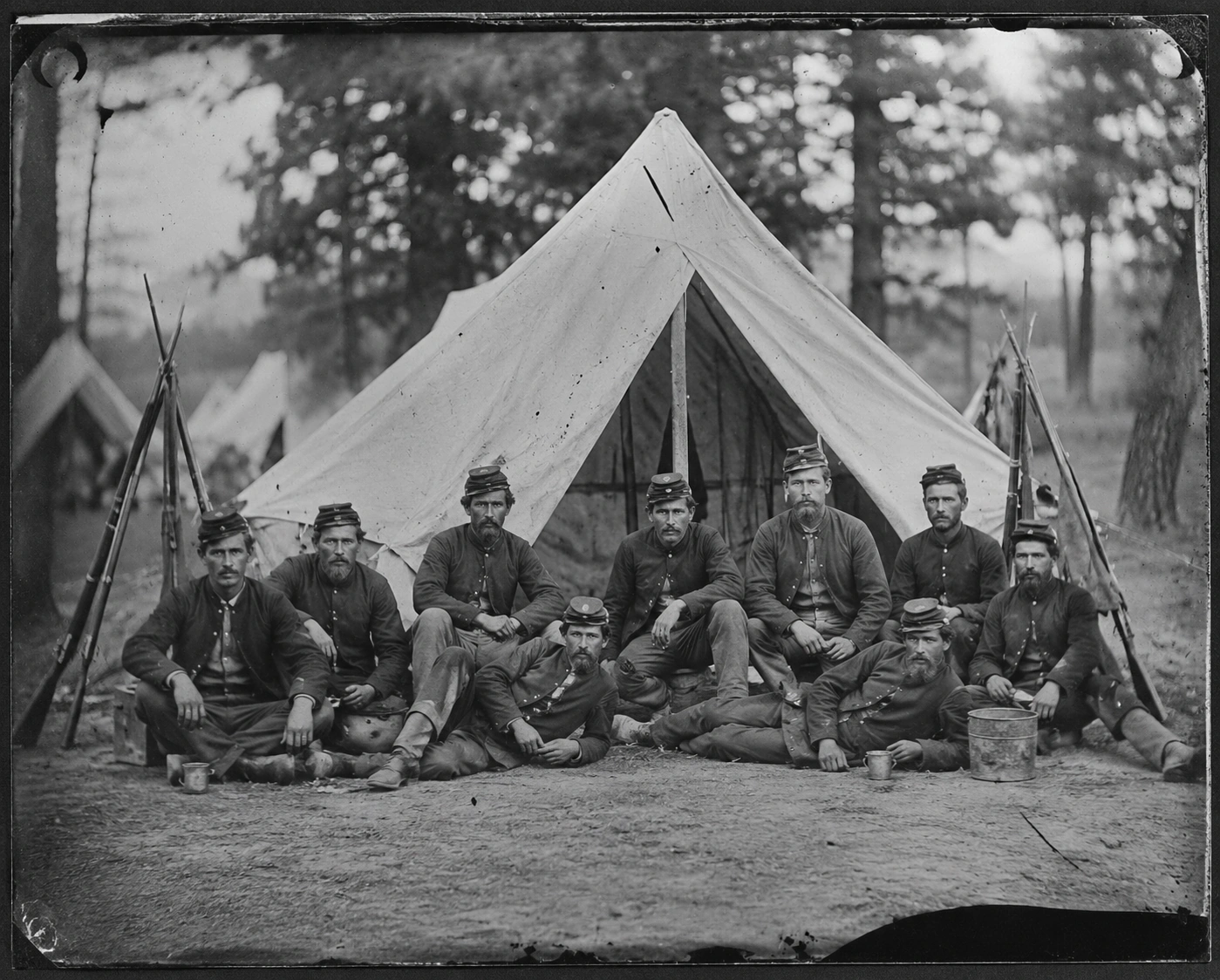
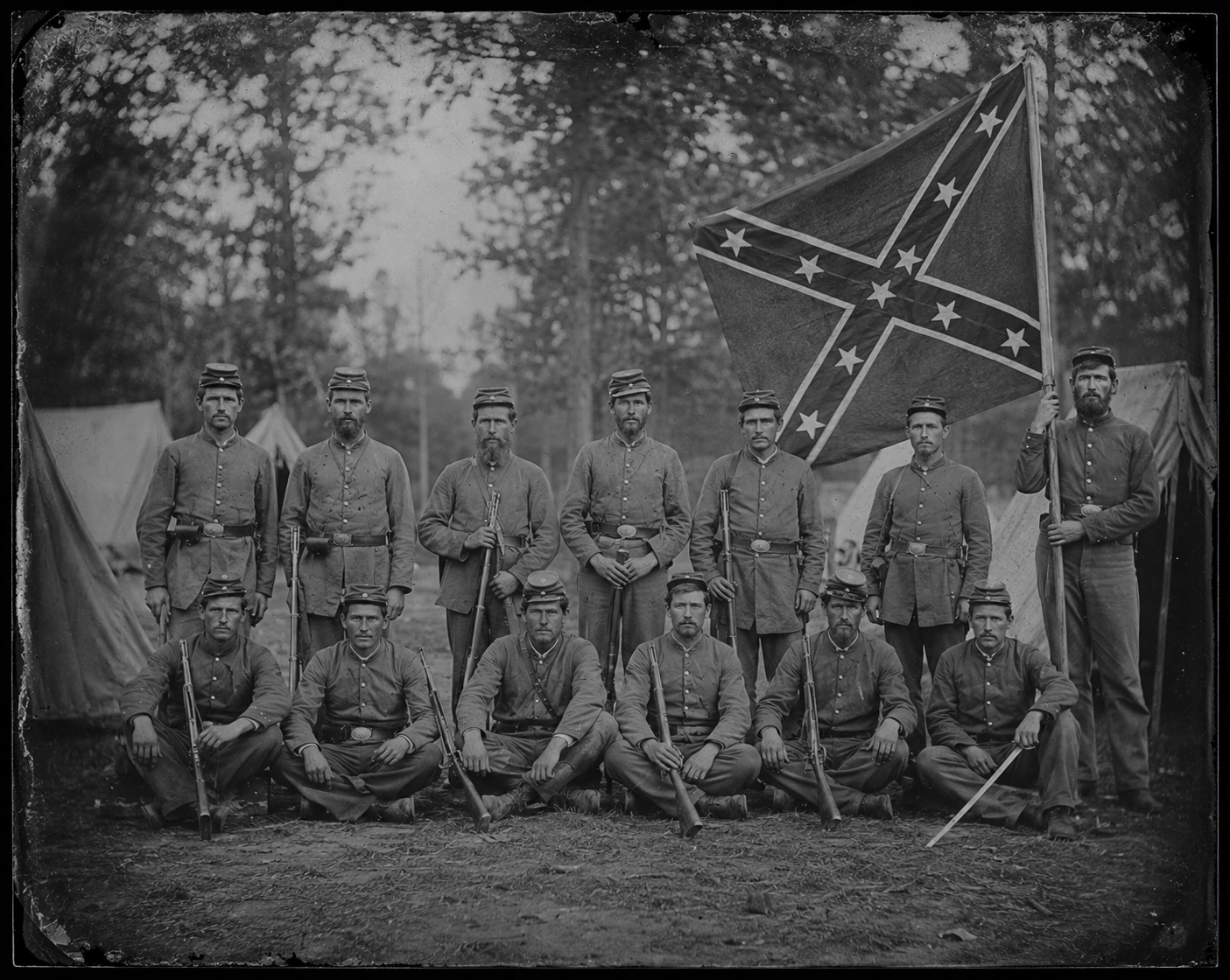
Both sides wore distinct uniforms — blue for the Union, gray or butternut for the Confederacy — and fought on multiple theaters (East, West, coast, trans-Mississippi).

Union soldiers — federal infantry, American Civil War
Union — U.S. Army
Confederate soldiers — Confederate States Army
Confederacy — Confederate States of America

4 · Root causes: slavery, economy, federalism

The Civil War did not erupt overnight: it condensed decades of tension between an industrializing North and an agricultural, slaveholding South, and a constitutional dispute over state sovereignty.

Slavery

Quatre millions d'esclavés en 1860 (recensement fédéral). L'expansion vers l'Ouest (Kansas-Nebraska, 1854) et l'arrêt Dred Scott (1857) relancent le débat. La plateforme républicaine de 1860 vise l'arrêt de l'extension de l'esclavage dans les territoires — perçue au Sud comme une menace existentielle.

Economy

The North developed factories, railroads, and banks; the South exported cotton and tobacco and imported manufactured goods. Protectionist tariffs (Morrill) favored Northern industry over Southern imports — a recurring fiscal conflict.

Federalism

Secessionists invoked "state sovereignty" and the right to leave the Union; Lincoln and Congress defended an indissoluble Union. The war also tested federal constitutional power and wartime executive authority.

Sources : National Archives — Emancipation Proclamation ; U.S. Census Bureau (1860) ; NPS — Causes of the Civil War.

5 · Geographic battle map

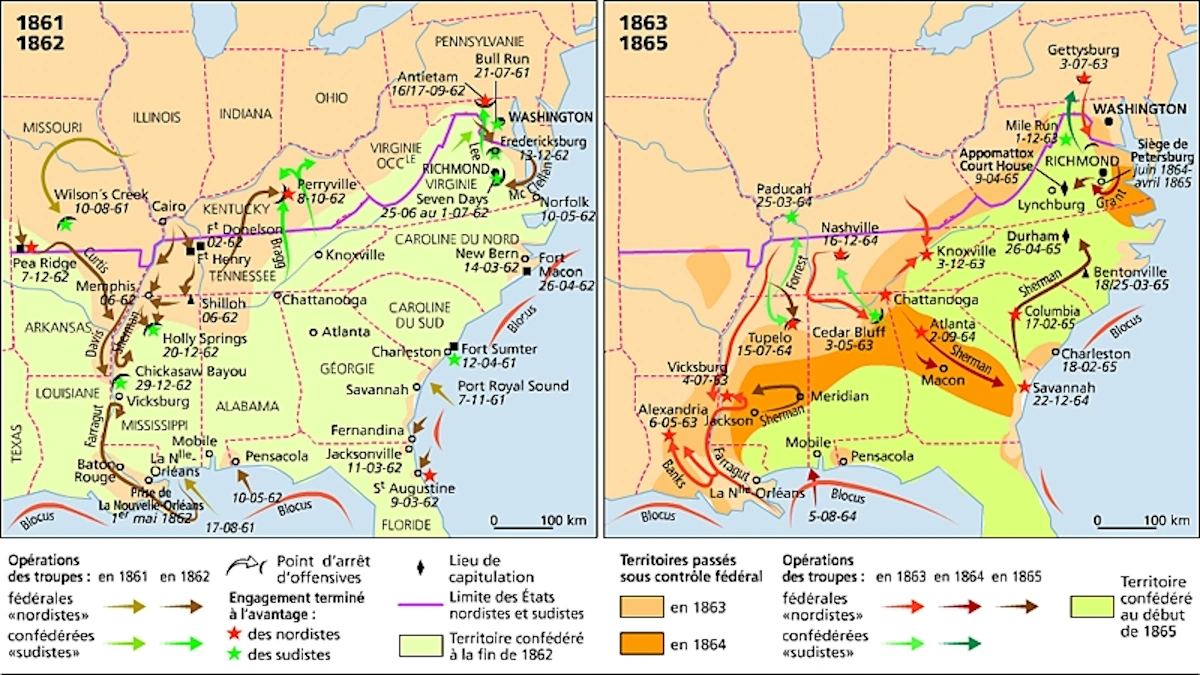
Spatial reference for major theaters (East, West, Atlantic coast, trans-Mississippi).

Map of American Civil War battles — Union and Confederacy
Map of major engagements (1861–1865). For each site: national military parks (NPS). Sources: NPS — American Civil War, Library of Congress — Civil War Maps.

6 · Union vs Confederacy

Synthetic comparison of both belligerents (1860–1865 data, historiographic estimates).

Union (United States) and Confederacy (Confederate States of America) — summary
Criterion Union Confederacy
Head of state / civilian commandAbraham Lincoln (President)Jefferson Davis (Confederate President)
Capital (wartime)Washington, D.C.Richmond, Virginia (1861–1865)
Population (≈ 1860)~22 million (North + border Union states)~9 million (including ~3.5 million enslaved)
Peak mobilized strength~2.1 million (army + navy)~880,000–1 million
MarineContinental blockade, naval supremacyCommerce raiding (Alabama, etc.)
EconomyIndustry, railroads, finance (greenbacks)Export agriculture (cotton), inflation
Foreign recognitionRecognized sovereign statesNo official recognition (UK, France)
War aimPreserve the Union, then abolition (1863+)Independence of Southern states
IssueMilitary and political victory (1865)Surrender (Lee at Appomattox, April 9, 1865)

Sources : U.S. Census Bureau (1860) ; National Archives — Civil War records ; Smithsonian — Price of Freedom ; NPS battle summaries.

7 · 5-minute summary (PDF)

Download the PDF guide: root causes (slavery, economy, federalism), key figures, battles (dates, places, casualties by side), and a full chronology from 1861 to 1865.

4 parts · ~5-minute read

  • Part A — Causes: slavery, economy, federalism
  • Part B — Key figures (Lincoln, Davis, Grant, Lee…)
  • Partie C — 16 battles (dates, lieux, pertes Union / Confederacy)
  • Part D — Chronological summary of the war

Educational PDF France-USA-Net.Com · Sources: nps.gov, archives.gov, loc.gov, history.army.mil

8 · American Civil War timeline

From the Missouri Compromise crisis to surrender at Appomattox — horizontal overview then detailed battles (NPS and national archives).

The timeline uses a tricolor legend: blue (Union / federal victory), orange (Confederacy / Southern victory) and gray (political context, stalemate, or indecisive battle). Scroll the horizontal strip for milestones from 1820 to 1865; the vertical timeline details sixteen major engagements with commanders, estimated casualties, and summaries aligned with National Park Service data.

Casualties shown are estimates (killed, wounded, missing, captured) compiled by the National Park Service and the U.S. Army Center of Military History. Figures vary by historian; for each site, consult official NPS brochures (Gettysburg, Shiloh, Antietam, Vicksburg, etc.).

Conflict milestones

  • 1861 — Fort Sumter ; première Bull Run ; start of industrial mobilization.
  • 1862 — Shiloh, Antietam ; Preliminary Emancipation Proclamation.
  • 1863 — Gettysburg, Vicksburg, conscription and Northern riots.
  • 1864 — Wilderness, Atlanta, marche vers la mer, Lincoln's re-election.
  • 1865 — Fall of Richmond, Appomattox, 13th Amendment (abolition).
  • Recent estimate — about 750,000 military and civilian deaths (Smithsonian, order of magnitude).
« The Civil War was not a Sunday stroll. » — Lesson from First Bull Run's civilian observers, then three years of large-scale fighting.
Union / Northern victory Confederacy / Southern victory Context or mixed outcome
1820

Missouri Compromise

Balance of slave and free states: Missouri entered as a slave state, Maine as free; slavery banned north of 36°30' (except Missouri).

Precursor to territorial crises leading to the Kansas-Nebraska Act (1854).

1854

Kansas-Nebraska Act

Senator Stephen A. Douglas opened these territories to popular sovereignty, undoing part of the 1820 compromise and triggering "Bleeding Kansas."

Violence between abolitionists and pro-slavery forces in Kansas — a miniature of the national conflict.

Nov. 1860

Election of Abraham Lincoln

The Republican candidate won the presidency without a single Southern state; secessionists saw a threat to slavery and state sovereignty.

Republican platform: no extension of slavery in federal territories.

Dec. 1860

Secession of Southern states

South Carolina left the Union December 20; six more states followed before Lincoln's inauguration, forming the Confederate States (February 1861).

Jefferson Davis elected Confederate president; provisional capital at Montgomery then Richmond.

avr. 1861

Fort Sumter

After 34 hours of bombardment, the federal garrison at Charleston surrendered; Lincoln then called for 75,000 volunteers — war officially began.

Quatre États de la haute Sud rejoignent la Confederacy après l'appel fédéral.

July 1861

First Bull Run

First major battle at Manassas (Virginia): heroic Confederate charge, McDowell's army routed toward Washington.

End of the short-war illusion; Stonewall Jackson emerges.

avr. 1862

Shiloh

Grant held against Johnston's surprise attack in Tennessee; among the bloodiest battles so far, turning toward Mississippi control.

Death of Albert Sidney Johnston — highest-ranking Confederate killed in action.

Sept. 1862

Antietam

Journée la plus meurtrière de l'histoire américaine (Sharpsburg, Maryland) ; Lee se retire, permettant à Lincoln de publier la Preliminary Emancipation Proclamation.

Special Orders 191 found by Union soldiers — intelligence advantage.

janv. 1863

Proclamation d'émancipation

À compter du 1er janvier 1863, les personnes tenues en esclavage dans les États en rébellion sont déclarées libres — tournant moral et politique du conflit.

Ne s'applique pas aux États frontaliers unionistes ; le 13e amendement achève l'abolition (1865).

July 1863

Gettysburg

Trois jours en Pennsylvania : échec de la charge de Pickett, retraite de l'armée de Lee — souvent considérée comme le « tournant » de la guerre dans l'Est.

Même été : surrender de Vicksburg le 4 July — double échec Confederate.

July 1863

Vicksburg

Grant force la surrender de la forteresse sur le Mississippi le 4 July ; l'Union coupe la Confederacy en deux.

Siège de 47 jours ; ~29 000 Confédérés capturés.

avr. 1865

Appomattox Court House

Lee surrenders to Grant ; major military end of the Civil War in the East (though fighting continued elsewhere).

Generous terms de Grant ; autres armées Confederates surrender through June.

Reading the vertical timeline

Each card follows the color legend. Badges indicate tactical or strategic outcome. Bullet lists highlight NPS-documented points for field visits or schoolwork.

12–14 April 1861

Fort Sumter (Charleston, South Carolina)

Confederate victory

Commanders: P. G. T. Beauregard (Confederacy) · Robert Anderson (Union)

Casualties (estimate): Union: none killed au combat (1 accidental death à la surrender) · Confederacy : negligible

After des mois de crise autour des forts fédéraux de Charleston, le président Confederate Jefferson Davis ordonne le bombardement. Le 12 April 1861, à 4 h 30, les canons Confederates tirent sur Sumter ; la garrison de l'artilleur major Robert Anderson répond avec un effectif réduit.

After trente-quatre heures, Anderson, short of munitions et de vivres, negotiates sa surrender honorable. Aucun soldat was not killed au combat ; un homme de l'Union meurt accidentellement lors des salves de canon de victoire après la cérémonie de retrait.

Lincoln proclaims l'insurrection et appelle 75 000 volunteers pour 90 jours ; la Virginia, l'Arkansas, le Tennessee et la Caroline du Nord rejoignent la Confederacy. Le conflit passe d'une crise constitutionnelle à une guerre civile on a large scale. Le site est administré par le Fort Sumter and Fort Moultrie National Historical Park (NPS).

Les canons Confederates tirèrent plus de 3 000 obus ; la garrison répondit avec environ 1 000 coups. Anderson reçut les honneurs militaires à la surrender.

For field or library research, NPS and National Archives offer brochures, maps, and archives on Fort Sumter — key references listed above.

  • Bombardment duration: about 34 hours.
  • Union garrison: ~85 men under Robert Anderson.
  • First Confederate cannon shot: 12 April 1861, 4:30 a.m.
  • NPS site: Fort Sumter and Fort Moultrie National Historical Park.
  • Anderson raised the Stars and Stripes at surrender on April 14.
  • Les États de la haute Sud rejoignent la Confederacy après l'appel de Lincoln.
  • Plans, brochures, and Junior Ranger programs: nps.gov (relevant park).
  • Photographs, maps, and newspapers: National Archives Catalog & Library of Congress.
  • Field visit: NPS visitor centers, interpretive trails, and commemorative plaques.
  • Research: Official Records (War of the Rebellion), M and T series at National Archives.
21 July 1861

First Battle of Bull Run (Manassas)

Confederate victory

Commanders: Irvin McDowell (Union) · Joseph E. Johnston & P. G. T. Beauregard (Confederacy) · Thomas J. Jackson (« Stonewall »)

Casualties (estimate): Union: ~2 900 (dont ~480 killed) · Confederacy : ~2 000 (dont ~390 killed)

L'armée du Potomac du brigadier général Irvin McDowell avance lentement vers Manassas Junction, retardée par des civils et congressistes qui bloquent les routes. Beauregard défend les hauteurs ; Joseph E. Johnston arrive par chemin de fer depuis la vallée avec des renforts décisifs.

Le 21 July, une attaque fédérale sur Henry House Hill est repulsed ; le brigadier Thomas J. Jackson tient sa ligne « comme un mur de pierre » — surnom Stonewall. Une contre-offensive Confederate sur le flanc droit routs l'Union ; retraite chaotique vers Washington.

Pertes comparables des deux côtés, Mays choc psychologique majeur au Nord : la guerre exigera armée professionnelle, financement et durée. Le NPS administore le Manassas National Battlefield Park sur les deux battles de Bull Run.

Une seconde battle de Bull Run (août 1862) se tiendra au même endroit, avec une federal defeat encore plus lourde sous Pope.

For field or library research, NPS and National Archives offer brochures, maps, and archives on First Battle of Bull Run — key references listed above.

  • First major land battle of the war.
  • Johnston's reinforcements by railroad — logistical innovation.
  • Nickname "Bull Run" (North) / "Manassas" (South) for the same place.
  • NPS park: Manassas National Battlefield Park.
  • Plans, brochures, and Junior Ranger programs: nps.gov (relevant park).
  • Photographs, maps, and newspapers: National Archives Catalog & Library of Congress.
  • Field visit: NPS visitor centers, interpretive trails, and commemorative plaques.
  • Research: Official Records (War of the Rebellion), M and T series at National Archives.
6–7 April 1862

Shiloh (Pittsburg Landing, Tennessee)

Union victory (strategic)

Commanders: Ulysses S. Grant & Don Carlos Buell (Union) · Albert Sidney Johnston & P. G. T. Beauregard (Confederacy)

Casualties (estimate): Union: ~13 000 · Confederacy : ~10 700 (Johnston killed le premier jour)

Le 6 April 1862, l'armée du Mississippi d'Albert Sidney Johnston surprend Grant campé près de l'église Shiloh (Tennessee). Les fédéraux reculent vers Pittsburg Landing ; Johnston est mortellement blessé en menant une charge près du Peach Orchard.

Le général Beauregard suspend les assauts le soir ; pendant la nuit, le corps de Don Carlos Buell et des unités de Lew Wallace renforcent Grant. Le 7 April, l'Union reprend l'initiative ; Beauregard se retire vers Corinth, Mississippi.

Environ 23 700 wounded et killed des deux côtés — chiffres alors sans précédent. Shiloh démontre la violence industrielle du conflit et propulse Grant vers le commandement de l'Ouest. Parc national NPS : Shiloh National Military Park.

For field or library research, NPS and National Archives offer brochures, maps, and archives on Shiloh — key references listed above.

  • Plus de 100 000 soldats engagés sur deux jours.
  • Johnston : plus haut gradé Confederate killed au combat.
  • Église Shiloh = nom choisi par les cartographes (paix).
  • NPS : Shiloh National Military Park (Tennessee).
  • Plans, brochures, and Junior Ranger programs: nps.gov (relevant park).
  • Photographs, maps, and newspapers: National Archives Catalog & Library of Congress.
  • Field visit: NPS visitor centers, interpretive trails, and commemorative plaques.
  • Research: Official Records (War of the Rebellion), M and T series at National Archives.
17 September 1862

Antietam (Sharpsburg, Maryland)

Union victory (strategic)

Commanders: George B. McClellan (Union) · Robert E. Lee (Confederacy)

Casualties (estimate): Union: ~12 400 · Confederacy : ~10 300 — journée la plus meurtrière de l'histoire américaine

Robert E. Lee envahit le Maryland en September 1862 pour une campagne politique et logistique. Une copie des ordres confédéraux (Special Orders 191) est trouvée par des soldats de l'Union et transmise à McClellan, qui rattrape Lee près d'Antietam Creek.

Le 17 September, combats simultanés à la Cornfield (tour de force matinale), à la Sunken Road (« Bloody Lane ») et au Burnside Bridge. Aucun camp n'obtient de percée décisive ; Lee se retire vers la Virginia pendant la nuit du 18.

McClellan ne poursuit pas assez vite — Lincoln le releve peu après. Victoire stratégique de l'Union: elle justifie la Proclamation d'émancipation préliminaire (22 September 1862). Antietam National Battlefield (NPS) préserve le site.

For field or library research, NPS and National Archives offer brochures, maps, and archives on Antietam — key references listed above.

  • ~23 000 victimes en une journée — record américain.
  • Cornfield : taux de pertes extrême en quelques minutes.
  • Proclamation préliminaire : 22 September 1862.
  • NPS : Antietam National Battlefield (Maryland).
  • Plans, brochures, and Junior Ranger programs: nps.gov (relevant park).
  • Photographs, maps, and newspapers: National Archives Catalog & Library of Congress.
  • Field visit: NPS visitor centers, interpretive trails, and commemorative plaques.
  • Research: Official Records (War of the Rebellion), M and T series at National Archives.
11–15 December 1862

Fredericksburg (Virginia)

Confederate victory

Commanders: Ambrose E. Burnside (Union) · Robert E. Lee & James Longstreet (Confederacy)

Casualties (estimate): Union: ~12 600 · Confederacy : ~5 300

Burnside remplace McClellan et lance une offensive hivernale vers Richmond. Les ponts de pontons retardent le passage du Rappahannock ; Lee dispose ses forces sur les hauteurs à l'ouest de Fredericksburg.

Du 13 au 15 December, des vagues fédérales assaillent Marye's Heights et le secteur Prospect Hill ; les Confédérés, abrités derrière un mur de pierre et la rue Sunken Road, infligent des pertes dévastatrices.

L'Union se replie ; Lee envoie un télégramme célèbre regrettant de n'avoir pu tuer davantage d'ennemis. Moral nordiste en chute ; Burnside cède le commandement à Hooker. Fredericksburg & Spotsylvania NMP (NPS).

For field or library research, NPS and National Archives offer brochures, maps, and archives on Fredericksburg — key references listed above.

  • Marye's Heights : mur de pierre et Sunken Road.
  • Burnside : responsable aussi de la « moustache ».
  • Ville bombardée avant le franchissement du fleuve.
  • NPS : Fredericksburg & Spotsylvania National Military Park.
  • Plans, brochures, and Junior Ranger programs: nps.gov (relevant park).
  • Photographs, maps, and newspapers: National Archives Catalog & Library of Congress.
  • Field visit: NPS visitor centers, interpretive trails, and commemorative plaques.
  • Research: Official Records (War of the Rebellion), M and T series at National Archives.
1–6 May 1863

Chancellorsville (Virginia)

Confederate victory

Commanders: Joseph Hooker (Union) · Robert E. Lee & Thomas J. Jackson (Confederacy)

Casualties (estimate): Union: ~17 200 · Confederacy : ~13 300 (Jackson mortellement blessé par tir ami)

Hooker manœuvre avec supériorité numérique autour du hamlet de Chancellorsville, dans la Wilderness. Lee divise son armée — Jackson contourne par la droite le 2 May et écrase le flanc droit fédéral.

Jackson est blessé par tir ami le soir ; son bras est amputé et enterré séparément (Chancellorsville). Il meurt le 10 May de pneumonie. Lee gagne tactiquement Mays perd son meilleur lieutenant.

Hooker se replie au-delà du Rappahannock ; l'Union subit ~30 % de pertes dans les corps touchés. Lee prépare l'invasion de Pennsylvania — prélude à Gettysburg. Site intégré au Fredericksburg & Spotsylvania NMP.

For field or library research, NPS and National Archives offer brochures, maps, and archives on Chancellorsville — key references listed above.

  • Lee divise son armée face à une force supérieure.
  • Blessure de Jackson : tir ami du 11e Virginia.
  • Victoire « Pyrrhus » pour la Confederacy.
  • Secteur de la Wilderness, Virginia.
  • Plans, brochures, and Junior Ranger programs: nps.gov (relevant park).
  • Photographs, maps, and newspapers: National Archives Catalog & Library of Congress.
  • Field visit: NPS visitor centers, interpretive trails, and commemorative plaques.
  • Research: Official Records (War of the Rebellion), M and T series at National Archives.
1–3 July 1863

Gettysburg (Pennsylvania)

Union victory

Commanders: George G. Meade (Union) · Robert E. Lee (Confederacy) · Joshua L. Chamberlain (Little Round Top)

Casualties (estimate): Union: ~23 000 · Confederacy : ~23 000–28 000

Des cavaliers Confederates entrent à Gettysburg à la recherche de chaussures ; l'affrontement grossit en battle de trois jours. Le 1er July, l'Union se replie vers Cemetery Hill ; les jours suivants, combats pour Culp's Hill, Little Round Top (20e Maine de Chamberlain) et Cemetery Ridge.

Le 3 July, la charge de Pickett — ~12 500 hommes à découvert — est brisée au centre ; l'armée de Lee se retire vers la Virginia le 4 July, jour de la surrender de Vicksburg.

Le 19 novembre, Lincoln prononce l'adresse de Gettysburg sur le cimetière national. Gettysburg National Military Park (NPS) : monuments, musée et champs de battle parmi les plus visités des États-Unis.

For field or library research, NPS and National Archives offer brochures, maps, and archives on Gettysburg — key references listed above.

  • ~165 000 soldats au total sur trois jours.
  • Pickett's Charge : division de Pickett, Pettigrew, Trimble.
  • Cimetière national consacré Nov. 1863.
  • NPS : Gettysburg National Military Park (Pennsylvania).
  • Plans, brochures, and Junior Ranger programs: nps.gov (relevant park).
  • Photographs, maps, and newspapers: National Archives Catalog & Library of Congress.
  • Field visit: NPS visitor centers, interpretive trails, and commemorative plaques.
  • Research: Official Records (War of the Rebellion), M and T series at National Archives.
18 May – 4 July 1863

Siege of Vicksburg (Mississippi)

Union victory

Commanders: Ulysses S. Grant & William T. Sherman (Union) · John C. Pemberton (Confederacy)

Casualties (estimate): Campagne : dizaines de milliers ; surrender : ~29 000 soldats Confederates capturés

Vicksburg, « Gibraltar du Mississippi », contrôle le fleuve. Grant contourne les défenses après victoires à Port Gibson, Raymond et Champion Hill (May 1863), puis investit la ville.

Quarante-sept jours de siège : civils et soldats Confederates vivent dans des grottes creusées dans les falaises ; rationnement sévère. Des assauts fédéraux échouent le 22 May ; Grant opte pour l'affamement.

Pemberton capitule le 4 July 1863 ; ~29 000 soldats sudistes se rendent. Avec Gettysburg, double tournant de l'été 1863. Vicksburg National Military Park (NPS) commémore la campagne et le cimetière national.

For field or library research, NPS and National Archives offer brochures, maps, and archives on Siege of Vicksburg — key references listed above.

  • 47 jours de siège après l'investissement.
  • Grottes « Pope's Cave » dans les falaises de loess.
  • 4 July 1863 : date symbolique de surrender.
  • NPS : Vicksburg National Military Park.
  • Plans, brochures, and Junior Ranger programs: nps.gov (relevant park).
  • Photographs, maps, and newspapers: National Archives Catalog & Library of Congress.
  • Field visit: NPS visitor centers, interpretive trails, and commemorative plaques.
  • Research: Official Records (War of the Rebellion), M and T series at National Archives.
19–20 September 1863

Chickamauga (Georgia / Tennessee)

Confederate victory

Commanders: William S. Rosecrans & George H. Thomas (Union) · Braxton Bragg (Confederacy)

Casualties (estimate): Union: ~16 200 · Confederacy : ~18 500

After la campagne de Tullahoma, Rosecrans pousse Bragg vers la Georgia. À Chickamauga Creek (« rivière du sang » en langue cherokee), la plus grande battle de l'Ouest se déroule sur deux jours.

Une erreur de coordination fédérale ouvre un « gap » dans la ligne ; James Longstreet, transféré de l'Est, en profite pour briser le centre et mettre en routs une partie de l'armée de Rosecrans.

George H. Thomas tient Snodgrass Hill (« Rock of Chickamauga ») et couvre la retraite vers Chattanooga. Bragg assiège Chattanooga Mays n'enlève pas la ville — Grant viendra lever le siège. Chickamauga & Chattanooga NMP (NPS).

For field or library research, NPS and National Archives offer brochures, maps, and archives on Chickamauga — key references listed above.

  • Plus grande battle de l'armée de l'Ouest.
  • Longstreet transféré après Gettysburg.
  • Thomas : « Rock of Chickamauga ».
  • NPS : Chickamauga & Chattanooga National Military Park.
  • Plans, brochures, and Junior Ranger programs: nps.gov (relevant park).
  • Photographs, maps, and newspapers: National Archives Catalog & Library of Congress.
  • Field visit: NPS visitor centers, interpretive trails, and commemorative plaques.
  • Research: Official Records (War of the Rebellion), M and T series at National Archives.
23–25 novembre 1863

Chattanooga (Lookout Mountain, Missionary Ridge)

Union victory

Commanders: Ulysses S. Grant & George H. Thomas & William T. Sherman (Union) · Braxton Bragg (Confederacy)

Casualties (estimate): Union: ~5 800 · Confederacy : ~6 700

After Chickamauga, l'armée de Rosecrans est assiégée à Chattanooga (« Crise du pain »). Lincoln nomme Grant commandant en chef des armées de l'Ouest ; Sherman et Thomas relèvent les lignes de ravitaillement (« Cracker Line »).

Le 24 novembre, les troupes de Hooker prennent Lookout Mountain (« Battle Above the Clouds »). Le 25, Thomas lance une charge non ordonnée sur Missionary Ridge qui emporte trois lignes Confederates.

Bragg se replie vers la Georgia ; l'Union ouvre la route vers Atlanta. Chattanooga devient base logistique pour la campagne de Sherman. NPS park: Chickamauga & Chattanooga National Military Park.

For field or library research, NPS and National Archives offer brochures, maps, and archives on Chattanooga — key references listed above.

  • « Cracker Line » rétablit les rations.
  • Lookout Mountain : brouillard le 24 Nov.
  • Missionary Ridge : charge non ordonnée de Thomas.
  • Ouverture de la route vers Atlanta.
  • Plans, brochures, and Junior Ranger programs: nps.gov (relevant park).
  • Photographs, maps, and newspapers: National Archives Catalog & Library of Congress.
  • Field visit: NPS visitor centers, interpretive trails, and commemorative plaques.
  • Research: Official Records (War of the Rebellion), M and T series at National Archives.
5–7 May 1864

Wilderness (Virginia)

Indécis (avantage tactique Confédéré)

Commanders: Ulysses S. Grant & George G. Meade (Union) · Robert E. Lee (Confederacy)

Casualties (estimate): Union: ~17 700 · Confederacy : ~11 400

Grant, promu lieutenant général commandant toutes les armées de l'Union, s'associe à Meade et entre dans la Wilderness de Virginia — broussailles denses où la cavalerie et l'artillerie sont limitées.

Lee engage immédiatement ; combats au corps à corps autour de la plate-forme de Grant et du saule de Chancellorsville. Des incendies de broussailles brûlent des wounded incapables de fuir.

Tactiquement coûteux pour les deux camps, Mays Grant ne se replie pas vers Washington : il contourne Lee vers Spotsylvania — début de la campagne Overland et de la guerre d'usure. Wilderness fait partie du Fredericksburg & Spotsylvania NMP.

For field or library research, NPS and National Archives offer brochures, maps, and archives on Wilderness — key references listed above.

  • Première rencontre Grant–Lee.
  • Incendies de broussailles : wounded piégés.
  • Campagne Overland : Spotsylvania, Cold Harbor.
  • NPS : Wilderness battlefield (Fredericksburg NMP).
  • Plans, brochures, and Junior Ranger programs: nps.gov (relevant park).
  • Photographs, maps, and newspapers: National Archives Catalog & Library of Congress.
  • Field visit: NPS visitor centers, interpretive trails, and commemorative plaques.
  • Research: Official Records (War of the Rebellion), M and T series at National Archives.
22 July – 2 September 1864

Atlanta (campagne)

Union victory

Commanders: William T. Sherman & James B. McPherson (Union) · Joseph E. Johnston puis John Bell Hood (Confederacy)

Casualties (estimate): Campagne : ~30 000+ des deux côtés ; battle d'Atlanta (22 July) : McPherson killed

Sherman avance depuis Chattanooga contre Johnston, qui mène une retraite manoeuvrière habile. Jefferson Davis remplace Johnston par Hood, plus agressif — battles de Peachtree Creek et Ezra Church (July 1864).

Le 22 July, Hood attaque les lignes de Sherman ; le général fédéral James B. McPherson est killed. Sherman investit Atlanta ; Hood évacue et fait sauter des dépôts le 1er–2 September.

La chute d'Atlanta galvanise le Nord avant l'élection de 1864 et permet la marche vers la mer. Kennesaw Mountain et Atlanta Campaign sites sont gérés par le NPS en Georgia.

For field or library research, NPS and National Archives offer brochures, maps, and archives on Atlanta — key references listed above.

  • McPherson : plus jeune commandant d'armée killed.
  • Hood remplace Johnston en July 1864.
  • Chute d'Atlanta : 2 September 1864.
  • Campagne commémorée en Georgia (NPS).
  • Plans, brochures, and Junior Ranger programs: nps.gov (relevant park).
  • Photographs, maps, and newspapers: National Archives Catalog & Library of Congress.
  • Field visit: NPS visitor centers, interpretive trails, and commemorative plaques.
  • Research: Official Records (War of the Rebellion), M and T series at National Archives.
15 novembre – 21 December 1864

March to the Sea (Sherman)

Union victory (strategic)

Commanders: William T. Sherman (Union) · William J. Hardee (Confederacy, Savannah)

Casualties (estimate): Combat direct limité ; ~600 killed environ · destruction des infrastructures Confederates

After Atlanta, Sherman propose une marche à travers la Georgia pour détruire la guerre de mouvement Confederate et le moral civil. ~60 000 fantassins avancent en colonnes larges vers Savannah, sans ligne de ravitaillement prolongée.

Les troupes détruisent rails (tordus en « neckties » autour des arbres), ponts, usines et dépôts de coton. Le général ordonne de limiter les exactions sur les civils, Mays la destruction économique est massive.

Savannah capitule le 21 December 1864 ; Sherman offre la ville à Lincoln comme cadeau de Noël. Campagne étudiée comme proto-guerre totale moderne. Sites NPS le long de la route historique March to the Sea.

For field or library research, NPS and National Archives offer brochures, maps, and archives on March to the Sea — key references listed above.

  • Largeur de front : ~60 km (20 miles).
  • Savannah offerte à Lincoln comme « cadeau ».
  • Stratégie de destruction économique.
  • Route historique March to the Sea (NPS).
  • Plans, brochures, and Junior Ranger programs: nps.gov (relevant park).
  • Photographs, maps, and newspapers: National Archives Catalog & Library of Congress.
  • Field visit: NPS visitor centers, interpretive trails, and commemorative plaques.
  • Research: Official Records (War of the Rebellion), M and T series at National Archives.
30 novembre 1864

Franklin (Tennessee)

Union victory

Commanders: John M. Schofield (Union) · John Bell Hood (Confederacy)

Casualties (estimate): Union: ~2 300 · Confederacy : ~6 000–7 000 (six généraux Confederates killed ou mortellement wounded)

Hood, commandant l'armée du Tennessee, tente de reprendre Nashville. Il force Schofield à combattre à Franklin avant la jonction avec Thomas — assauts frontaux répétés contre des retranchements fédéraux près du Carter House.

Six généraux Confederates sont killed ou mortellement wounded (dont Patrick Cleburne). Les pertes sudistes dépassent 6 000 ; l'armée arrive épuisée devant Nashville.

Souvent comparée à la charge de Pickett (« Pickett's Charge de l'Ouest »). Franklin Battlefield et Carter House sont préservés par le Battle of Franklin Trust et le NPS (partenariats).

For field or library research, NPS and National Archives offer brochures, maps, and archives on Franklin — key references listed above.

  • Carter House : centaines de impacts de balles.
  • Cleburne killed — général irlandais renommé.
  • Hood perd ~20 % de son armée en heures.
  • Franklin Battlefield Trust / NPS partenaires.
  • Plans, brochures, and Junior Ranger programs: nps.gov (relevant park).
  • Photographs, maps, and newspapers: National Archives Catalog & Library of Congress.
  • Field visit: NPS visitor centers, interpretive trails, and commemorative plaques.
  • Research: Official Records (War of the Rebellion), M and T series at National Archives.
15–16 December 1864

Nashville (Tennessee)

Union victory

Commanders: George H. Thomas (Union) · John Bell Hood (Confederacy)

Casualties (estimate): Union: ~3 000 · Confederacy : ~6 000 (armée du Tennessee anéantie)

George H. Thomas, « Rock of Chickamauga », accumule des renforts à Nashville malgré la pression de Grant pour attaquer vite. Hood assiège partiellement la ville ; Thomas sort le 15 December avec une supériorité numérique et matérielle.

Charges de cavalerie et d'infanterie sur les flancs Confederates ; le 16, l'armée de Hood s'effondre vers le sud. L'armée du Tennessee cesse d'être une force offensive majeure.

Dernière grande battle ouverte de la guerre dans l'Ouest. Thomas est surnommé « The Rock » ; la victoire sécurise le Tennessee pour l'Union. Monuments et sites à Nashville commémorés par le NPS et l'État.

For field or library research, NPS and National Archives offer brochures, maps, and archives on Nashville — key references listed above.

  • Thomas attend les renforts malgré la pression.
  • Cavalerie de Wilson sur les flancs Confederates.
  • Fin de l'armée du Tennessee offensive.
  • Monuments à Nashville et sites d'État.
  • Plans, brochures, and Junior Ranger programs: nps.gov (relevant park).
  • Photographs, maps, and newspapers: National Archives Catalog & Library of Congress.
  • Field visit: NPS visitor centers, interpretive trails, and commemorative plaques.
  • Research: Official Records (War of the Rebellion), M and T series at National Archives.
9 April 1865

Appomattox Court House (Virginia)

Capitulation de l'armée de Virginia du Nord

Commanders: Ulysses S. Grant (Union) · Robert E. Lee (Confederacy)

Casualties (estimate): Dernière phase : pertes légères ; ~28 000 Confédérés se rendent

After la rupture des lignes de Petersburg (April 1865) et l'abandon de Richmond, l'armée de Lee se retire vers l'ouest. Sheridan bloque la route à Appomattox Court House ; provisions Confederates épuisées.

Le 9 April, Lee demande une entrevue ; Grant offre des termes généreux inspirés de leur service commun en Mexique : officiers gardent leurs sabres et chevaux, soldats rentrent chez eux après paroles d'honneur.

La surrender dans le salon de McLean symbolise la fin militaire majeure dans l'Est. D'autres armées Confederates surrender through June ; le CSS Shenandoah cesse le combat en novembre. Appomattox Court House NHP (NPS).

For field or library research, NPS and National Archives offer brochures, maps, and archives on Appomattox Court House — key references listed above.

  • McLean House : lieu de signature.
  • Termes de Grant : chevaux des officiers conservés.
  • ~28 000 Confédérés parolés.
  • NPS : Appomattox Court House National Historical Park.
  • Plans, brochures, and Junior Ranger programs: nps.gov (relevant park).
  • Photographs, maps, and newspapers: National Archives Catalog & Library of Congress.
  • Field visit: NPS visitor centers, interpretive trails, and commemorative plaques.
  • Research: Official Records (War of the Rebellion), M and T series at National Archives.

9 · Verified anecdotes

Thirty-two facts documented by NPS, Smithsonian, Library of Congress, or National Archives — no urban legends.

Verification method

The thirty-two entries below rely on institutional publications (NPS, Smithsonian, Library of Congress, National Archives, Naval History and Heritage Command, specialized museums). No deliberate urban legends: when a story is popular but disputed by historians, the source notes it (e.g., quote attributed to Wilmer McLean, documented at McLean House).

01

Wilmer McLean et les deux « premières battles »

En July 1861, Wilmer McLean, commerçant de Virginia, voit des observateurs civils pique-niquer près de sa ferme de Manassas lors de la première battle de Bull Run — le conflit touche déjà sa propriété.

Il déménage à Appomattox Court House pour fuir les combats. Quatre ans plus tard, le 9 April 1865, les officiers Confederates choisissent sa Mayson pour la surrender de Lee devant Grant.

McLean aurait dit que la guerre « a commencé dans son jardin et s'est terminée dans son salon » — anecdote souvent citée, documentée par le NPS au McLean House.

National Park Service — Appomattox Court House NHP
02

Le sous-marin H. L. Hunley

Le CSS H. L. Hunley, propulsé à la Mayn, est le premier sous-marin de combat à couler un navire ennemi : le USS Housatonic, le 17 February 1864, au large de Charleston.

Le Hunley disparaît la même nuit avec ses huit hommes d'équipage — cause encore débattue (champ de pression, collision). L'épave est retrouvée en 1995 et restaurée.

Conservation au Warren Lasch Conservation Center (Charleston) ; études conjointes Naval History and Heritage Command et archéologues.

Naval History and Heritage Command / Friends of the Hunley
03

Mary Edwards Walker, seule femme MOH

Médecin, abolitionniste et réformiste du costume, Mary Edwards Walker sert comme chirurgienne civile contractuelle pour l'armée de l'Union.

Elle reçoit la Medal of Honor en 1865 ; la médaille est révoquée en 1917 avec d'autres MOH civiles, puis rétablie à titre posthume en 1977 — elle reste la seule femme honorée pour la guerre de Sécession.

Le Smithsonian et l'Army conservent sa biographie comme pionnière des femmes en médecine militaire.

Smithsonian National Museum of American History
04

Émeutes de la conscription à New York (1863)

La loi de conscription de mars 1863 permet d'acheter un substitut pour 300 dollars — provoquant la colère des classes populaires, notamment irlandaises, à New York.

Du 13 au 16 July, des émeutiers saccagent des bureaux d'enrôlement et attaquent des Afro-Américains ; les estimations font au moins une centaine de morts.

Des troupes fraîches de Gettysburg répriment l'émeute — la plus grave révolte civile de l'histoire américaine. Library of Congress conserve gravures et rapports.

Library of Congress — « The Draft Riots »
05

Monitor contre CSS Virginia (ex-Merrimack)

Le 8 mars 1862, le cuirassé Confederate CSS Virginia (coque du Merrimack reconvertie) coule le Cumberland et force le Congress à Hampton Roads.

Le lendeMayn, l'USS Monitor à tourelle révolutionnaire affronte le Virginia ; combat indécis Mays le Monitor empêche la rupture du blocus.

Fin de l'ère des seuls navires en bois ; sanctuaire marin NOAA pour l'épave du Monitor. National Archives : plans et correspondance de la marine.

National Archives / NOAA Monitor National Marine Sanctuary
06

La Proclamation ne libère pas tous les esclaves

Le 1er janvier 1863, Lincoln ne cible que les États « en rébellion ». L'esclavage persiste légalement dans les États frontaliers unionistes (Kentucky, Missouri, Maryland, Delaware) jusqu'au 13e amendement (1865).

Source principale : National Archives — publications, expositions ou fonds numérisés consultables en ligne.

Les historiens professionnels croisent ces documents avec les Official Records de la guerre de Sécession.

National Archives — Emancipation Proclamation
07

Robert E. Lee avait refusé le commandement de l'Union

Officier de l'armée régulière, Lee décline en April 1861 de diriger les forces fédérales contre son État natal, la Virginia, et rejoint la Confederacy — choix personnel majeur de la crise sécessionniste.

Source principale : Library of Congress — publications, expositions ou fonds numérisés consultables en ligne.

Les historiens professionnels croisent ces documents avec les Official Records de la guerre de Sécession.

Library of Congress — papers of Robert E. Lee
08

Stonewall Jackson : bras enterré à Chancellorsville

Blessé par tir ami le 2 May 1863, Jackson subit l'amputation du bras ; le membre est enterré dans un cimetière de famille près du champ de battle. Le général meurt le 10 May de pneumonie. Son corps repose à Lexington, Virginia.

Source principale : Fredericksburg & Spotsylvania NMP (NPS) — publications, expositions ou fonds numérisés consultables en ligne.

Les historiens professionnels croisent ces documents avec les Official Records de la guerre de Sécession.

Fredericksburg & Spotsylvania NMP (NPS)
09

Andersonville : plus grand camp de prisonniers

Camp Sumter (Georgia) : des dizaines de milliers de prisonniers de l'Union ; ~13 000 morts par maladie et malnutrition. Le responsable Henry Wirz est le seul officier Confederate exécuté pour crimes de guerre après le conflit.

Source principale : Andersonville National Historic Site (NPS) — publications, expositions ou fonds numérisés consultables en ligne.

Les historiens professionnels croisent ces documents avec les Official Records de la guerre de Sécession.

Andersonville National Historic Site (NPS)
10

Clara Barton et la Croix-Rouge américaine

« Angel of the Battlefield » : elle soigne à Antietam et distribue des fournitures. Son expérience pendant la guerre mène à la fondation de l'American Red Cross en 1881.

Source principale : Clara Barton National Historic Site (NPS) — publications, expositions ou fonds numérisés consultables en ligne.

Les historiens professionnels croisent ces documents avec les Official Records de la guerre de Sécession.

Clara Barton National Historic Site (NPS)
11

Mathew Brady et la photographie de guerre

Brady et son équipe (Gardner, O'Sullivan) documentent camps, généraux et champs de battle — Antietam parmi les premières images directes de cadavres. Le public nordiste découvre la réalité du champ de battle.

Source principale : National Portrait Gallery / Library of Congress — publications, expositions ou fonds numérisés consultables en ligne.

Les historiens professionnels croisent ces documents avec les Official Records de la guerre de Sécession.

National Portrait Gallery / Library of Congress
12

L'adresse de Gettysburg : ~272 mots

Le 19 novembre 1863, Lincoln prononce environ deux minutes de discours ; l'orateur principal Edward Everett parle deux heures. Le texte de 272 mots (versions légèrement différentes) devient un pilier de la démocratie américaine.

Source principale : Library of Congress — publications, expositions ou fonds numérisés consultables en ligne.

Les historiens professionnels croisent ces documents avec les Official Records de la guerre de Sécession.

Library of Congress — Gettysburg Address
13

Thanksgiving national (1863)

Lincoln proclaims le dernier jeudi de novembre comme jour d'action de grâces national, en partie pour unifier le pays en guerre — tradition renforcée sous la présidence suivante.

Source principale : National Archives — publications, expositions ou fonds numérisés consultables en ligne.

Les historiens professionnels croisent ces documents avec les Official Records de la guerre de Sécession.

National Archives — Proclamation of Thanksgiving
14

La charge de Pickett

Le 3 July 1863, ~12 500 Confédérés traversent un mile à découvert ; plus de la moitié sont killed, wounded ou capturés. Longstreet aurait douté de l'ordre. Symbole de la limite offensive Confederate.

Source principale : Gettysburg National Military Park (NPS) — publications, expositions ou fonds numérisés consultables en ligne.

Les historiens professionnels croisent ces documents avec les Official Records de la guerre de Sécession.

Gettysburg National Military Park (NPS)
15

Ballons d'observation de Thaddeus Lowe

L'Union utilise des ballons captifs pour repérer les positions Confederates (Bull Run, Peninsula, Fredericksburg). Première utilisation militaire systématique de l'aérostation aux États-Unis.

Source principale : National Air and Space Museum — publications, expositions ou fonds numérisés consultables en ligne.

Les historiens professionnels croisent ces documents avec les Official Records de la guerre de Sécession.

National Air and Space Museum — Civil War balloon corps
16

La West Virginia naît de la guerre

Les comtés unionistes du nord-ouest de la Virginia se séparent ; l'État de Virginia-Occidentale entre dans l'Union le 20 juin 1863 — seul État créé par sécession d'un autre État.

Source principale : West Virginia State Archives / National Archives — publications, expositions ou fonds numérisés consultables en ligne.

Les historiens professionnels croisent ces documents avec les Official Records de la guerre de Sécession.

West Virginia State Archives / National Archives
17

Le siège de Petersburg : neuf mois

Juin 1864 – April 1865 : tranchées, mines (battle du Crater, 30 July 1864), usure. La chute de Petersburg entraîne l'abandon de Richmond.

Source principale : Petersburg National Battlefield (NPS) — publications, expositions ou fonds numérisés consultables en ligne.

Les historiens professionnels croisent ces documents avec les Official Records de la guerre de Sécession.

Petersburg National Battlefield (NPS)
18

Sherman et les « neckties » ferroviaires

Durant la marche vers la mer, les soldats chauffent et tordent les rails autour des arbres pour empêcher leur réutilisation rapide par les Confédérés.

Source principale : National Archives — publications, expositions ou fonds numérisés consultables en ligne.

Les historiens professionnels croisent ces documents avec les Official Records de la guerre de Sécession.

National Archives — Sherman papers / campaign maps
19

Affaire du Trent (1861)

Des marins de l'Union arrêtent les diplomates Confederates Mason et Slidell à bord du navire britannique Trent ; Londres exige leur libération. Crise diplomatique presque belliciste entre Washington et le Royaume-Uni.

Source principale : National Archives — publications, expositions ou fonds numérisés consultables en ligne.

Les historiens professionnels croisent ces documents avec les Official Records de la guerre de Sécession.

National Archives — U.S. Department of State records
20

CSS Alabama et guerre de course

Croiseur Confederate construit en Grande-Bretagne ; coule ou capture plus de 60 navires marchands unionistes. Coulé par le USS Kearsarge en 1864 au large de Cherbourg.

Source principale : Naval History and Heritage Command — publications, expositions ou fonds numérisés consultables en ligne.

Les historiens professionnels croisent ces documents avec les Official Records de la guerre de Sécession.

Naval History and Heritage Command
21

Belle Boyd, espionne Confederate

À Front Royal et ailleurs, elle transmet des renseignements aux troupes sudistes ; arrêtée plusieurs fois. Publié ses mémoires après la guerre.

Source principale : Library of Virginia / Smithsonian — publications, expositions ou fonds numérisés consultables en ligne.

Les historiens professionnels croisent ces documents avec les Official Records de la guerre de Sécession.

Library of Virginia / Smithsonian
22

Rose O'Neal Greenhow à Washington

Société de la capitale, elle transmet des informations à la Confederacy ; emprisonnée, puis expulsée vers le Sud. Meurt en mer en 1864.

Source principale : National Archives — publications, expositions ou fonds numérisés consultables en ligne.

Les historiens professionnels croisent ces documents avec les Official Records de la guerre de Sécession.

National Archives — intelligence in the Civil War
23

Les « Copperheads »

Démocrates du Nord pacifistes ou critiques de Lincoln (Clement Vallandigham) ; accusés de saper l'effort de guerre. Débats sur la liberté d'expression en temps de crise.

Source principale : Library of Congress — publications, expositions ou fonds numérisés consultables en ligne.

Les historiens professionnels croisent ces documents avec les Official Records de la guerre de Sécession.

Library of Congress — political cartoons 1863
24

Gatling gun (1861)

Richard Gatling brevète une mitrailleuse à plusieurs canons rotatifs pour « réduire le nombre de soldats sur le champ de battle » ; peu utilisée pendant la guerre, adoptée plus tard.

Source principale : Smithsonian — publications, expositions ou fonds numérisés consultables en ligne.

Les historiens professionnels croisent ces documents avec les Official Records de la guerre de Sécession.

Smithsonian — armed forces history
25

Le café, boisson des soldats

L'Union distribue massivement du café moulu ; les Confédérés, privés de commerce maritime, remplacent par chicorée ou grains torréfiés. Le café structure la vie de camp.

Source principale : National Museum of Civil War Medicine — publications, expositions ou fonds numérisés consultables en ligne.

Les historiens professionnels croisent ces documents avec les Official Records de la guerre de Sécession.

National Museum of Civil War Medicine
26

Baseball dans les camps

Les régiments jouent des matchs de « town ball » / proto-baseball pendant les temps morts — loisir et cohésion d'unité documentés dans des journaux de camp.

Source principale : National Baseball Hall of Fame — publications, expositions ou fonds numérisés consultables en ligne.

Les historiens professionnels croisent ces documents avec les Official Records de la guerre de Sécession.

National Baseball Hall of Fame — Civil War and baseball
27

Recensement de 1860 et enrôlement

Les listes de recensement servent à identifier les hommes éligibles à la conscription de 1863 ; tensions dans les villes où l'immigration et la pauvreté sont fortes.

Source principale : National Archives — publications, expositions ou fonds numérisés consultables en ligne.

Les historiens professionnels croisent ces documents avec les Official Records de la guerre de Sécession.

National Archives — 1860 census
28

Le 13e, 14e et 15e amendements

After la guerre : abolition (1865), citoyenneté et due process (1868), droit de vote masculin sans distinction de race (1870) — fondements du Reconstruction.

Source principale : National Archives — publications, expositions ou fonds numérisés consultables en ligne.

Les historiens professionnels croisent ces documents avec les Official Records de la guerre de Sécession.

National Archives — Charters of Freedom
29

Catastrophe du Sultana (1865)

Chaudières explosent sur le steamer Sultana sur le Mississippi (April 1865) ; ~1 200 morts, dont d'anciens prisonniers de Andersonville — pire désastre maritime américain de l'époque.

Source principale : National Archives — publications, expositions ou fonds numérisés consultables en ligne.

Les historiens professionnels croisent ces documents avec les Official Records de la guerre de Sécession.

National Archives — Mississippi River disaster reports
30

Lincoln et le télégraphe

La « tente de télégraphe » à la Maison Blanche permet à Lincoln de suivre les fronts en quasi temps réel — premier président ainsi connecté au champ de battle.

Source principale : Smithsonian — publications, expositions ou fonds numérisés consultables en ligne.

Les historiens professionnels croisent ces documents avec les Official Records de la guerre de Sécession.

Smithsonian — Lincoln's telegraph office
31

Trousse médicale et chirurgie de camp

Amputations sans antiseptique moderne ; chloroforme et éther pour l'anesthésie. La guerre accélère la médecine de trauma et les soins infirmiers féminins.

Source principale : National Museum of Civil War Medicine — publications, expositions ou fonds numérisés consultables en ligne.

Les historiens professionnels croisent ces documents avec les Official Records de la guerre de Sécession.

National Museum of Civil War Medicine
32

Fin de guerre, monuments et mémoire

After Appomattox (9 April 1865), l'armée du Tennessee de Joseph E. Johnston capitule le 26 April ; les forces trans-Mississippi le 2 juin.

Le croiseur CSS Shenandoah cesse les hostilités en novembre 1865 dans l'océan Indien — dernière unité de guerre Confederate.

Dès les années 1860, stèles et parcs militaires nationaux (NPS) structurent la mémoire ; débats contemporains sur l'interprétation des monuments.

National Archives — surrender documents / National Park Service — Civil War heritage

10 · Frequently asked questions

Why did the American Civil War break out in 1861?

The immediate trigger was the bombardment of Fort Sumter (April 12–14, 1861), after months of secession. Root causes combine slavery (territorial expansion, Kansas-Nebraska crisis, Dred Scott), economic tensions (protectionist tariffs, cotton dependence), and federalism (state sovereignty vs. indissoluble Union). Abraham Lincoln's election in November 1860, without votes in several Southern states, accelerated the break.

Sources: National Park Service — Causes of the Civil War; National Archives — milestones.
What is the difference between "Civil War" and "War of Secession"?

In English, American Civil War is standard (NPS, Smithsonian). In French, guerre de Sécession emphasizes Southern states leaving the Union; both refer to the same 1861–1865 conflict.

Sources: NPS — American Civil War portal; James M. McPherson, Battle Cry of Freedom.
How many deaths during the American Civil War?

Recent estimates (Smithsonian, demographic studies) are about 750,000 military and civilian deaths — the deadliest conflict in U.S. history for Americans. Per-battle figures on this page are NPS estimates; disease, prisons, and sieges raise totals beyond battlefields alone.

Sources: Smithsonian — Price of Freedom; NPS casualty summaries; J. David Hacker (2011).
Which battle was the turning point?

Historians often cite a dual shift in 1863: Gettysburg (July 1–3), where Lee's army was repulsed in Pennsylvania, and Vicksburg (surrender July 4), opening the Mississippi and splitting the Confederacy. Antietam (1862) enabled the Emancipation Proclamation; Atlanta and Sherman's march (1864) sealed strategic defeat.

Sources: NPS — Gettysburg NMP, Vicksburg NMP; U.S. Army Center of Military History.
What was the Emancipation Proclamation?

Signed by Lincoln on January 1, 1863, it declared enslaved people in rebelling states free — a military and moral instrument, not immediate abolition in loyal border states. Constitutional abolition came with the 13th Amendment (ratified December 1865). See the timeline (Antietam, 1862).

Sources: National Archives — Emancipation Proclamation; Congress.gov — 13th Amendment.
Who won and when did the war end?

The Union won militarily. Robert E. Lee surrendered to Ulysses S. Grant at Appomattox Court House on April 9, 1865; other Confederate armies followed. President Lincoln was assassinated April 14, 1865. Palmito Ranch (May 1865, Texas) is often cited as the last major land engagement.

Sources: NPS — Appomattox Court House NHP; National Archives — surrender documents.
Why did Southern states secede?

Secession conventions (December 1860 – February 1861) invoked protection of slavery, white state rights, and the perceived threat of the Republican Party. South Carolina was first (December 20, 1860); six more followed before Fort Sumter, then four Upper South states after Lincoln's call-up.

Sources: National Archives — secession documents; Library of Congress — Civil War collections.
What role did slavery play?

Slavery structured the Southern economy and national politics since the Missouri Compromise (1820). The war gradually shifted Union war aims from preservation to abolition (1863 Proclamation, 1865 amendment). More than 180,000 African American soldiers served in the Union army and navy by 1865.

Sources: National Archives — Emancipation; NPS — Civil Rights; U.S. Census 1860.
Did France or Britain support the Confederacy?

No European government officially recognized the Confederacy. Britain and France watched the conflict (cotton, neutrality) but did not ally with Richmond — especially after the Emancipation Proclamation moralized the Northern cause. Private blockade runners existed without treaties.

Sources: U.S. Department of State; Library of Congress; Howard Jones, Blue and Gray Diplomacy.
Which constitutional amendments came from the war?

The Reconstruction amendments: 13th (abolition, 1865), 14th (citizenship and equal protection, 1868), 15th (African American men's voting rights, 1870). They redefined federal–citizen relations and the war's legal legacy.

Sources: National Archives — 13th Amendment; Congress.gov.

11 · Official U.S. sources

For field or library research, use the institutional portals below rather than unverified accounts.

Explore American history

Cross-reference this feature with the War of Independence and the U.S. presidential election.

War of Independence Contact us