U.S. driver's licenses: understand state rules before you drive
A practical guide for visitors, students, expatriates, new residents and investors who need to drive or obtain a local license in the United States.
19 chaptersState rulesREAL ID checklistPDF
DMVstate authority
REAL IDenhanced identity
IDPlicense translation
CDLcommercial license
Scope
1. Purpose and limits of this guide
This guide helps French visitors, students, expatriates, investors, visa holders and new residents understand how driver's licensing works in the United States. It explains the general steps, documents, DMV role, differences between standard and REAL ID licenses, and the use of a foreign license with an International Driving Permit.
The United States does not have one single rule for every state. A tourist stay in Florida, relocation to California, F-1 status in New York or a move to Texas can create different obligations. This guide gives a reliable method, but the final rule always comes from the state involved.
Authority
2. No federal driver's license: each state sets its rules
Driver's licenses are issued by states, not by a single federal agency. The office may be called DMV, Department of Driver Services, Department of Public Safety, Registry of Motor Vehicles or another local name. That is why forms, fees, tests, residency documents and noncitizen requirements differ.
The federal government mainly affects driver's licenses through the REAL ID Act, which sets security standards for certain federal uses of a license or ID card. The state still reviews the application, issues the document and controls the practical process. Before doing anything, identify the state of residence or stay and use its official portal.
Steps
3. Complete process, step by step
The process starts with eligibility. The DMV reviews age, state residency, lawful presence, identity and sometimes Social Security Number or proof of ineligibility. A short-term visitor does not follow the same path as a new resident.
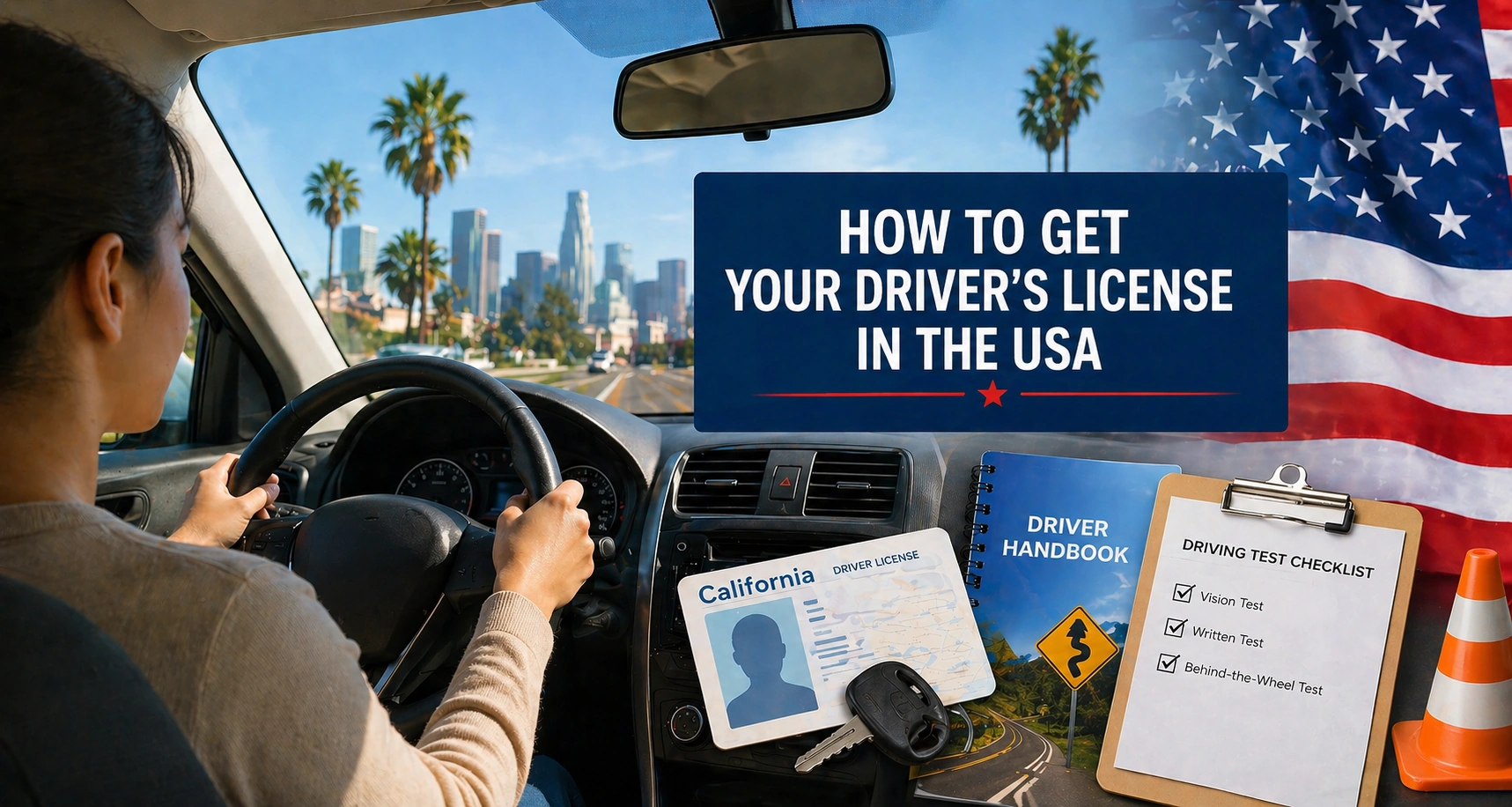
Next come documents and appointments. Many states require passport, visa or status document, I-94, proof of address and identity documents. A vision test is common. The knowledge test checks rules of the road, signs, right of way, alcohol, seat belts, distances and penalties. The behind-the-wheel test evaluates real driving: parking, intersections, lane changes, observation and vehicle control.
Identify the state and DMV office.
Check eligibility, documents and REAL ID.
Schedule an appointment if required.
Take vision, knowledge and road tests.
Receive a temporary or final license.
Situations
4. Complete table by status
Immigration or residency status strongly affects documents and possible license duration. The notes below are general. The state DMV must confirm.
Status
Foreign license
Local license
Typical documents
Tourist
Often temporary with foreign license and recommended IDP
Usually not intended for short visitors
Passport, foreign license, IDP
F-1 student
Varies by state
Possible if local resident
Passport, visa, I-94, I-20, address
Work visa
Short transition may apply
Often required after moving
Passport, I-94, proof of address, SSN if applicable
Green Card
Limited after becoming resident
Yes
Green Card, address, SSN
Naturalized citizen
N/A
Yes
Identity, address, SSN
Paths
5. Flow: foreign license, short stay, residency, local license
The simplest path is a short visitor: valid foreign license, IDP obtained before travel, rental-car compliance and local road rules. The path changes when there is residence, lease, employment, long-term studies or vehicle registration.
Tourism: foreign license and IDP as translation.
Longer stay: check the state threshold.
Relocation: gather residency and status documents.
DMV: tests, fees, photo and issuance.
PDF
6. REAL ID checklist
REAL ID requires enhanced verification of identity, lawful status, SSN or accepted equivalent, and state residency. The PDF checklist helps prepare a DMV appointment by category.
Common documents fall into four groups. Identity proof may include passport, birth certificate or recognized official document. Lawful presence may include visa, I-94, Green Card, I-20, DS-2019, EAD or USCIS document depending on status. State residency proof often requires two documents: lease, utility bill, bank statement, insurance, official mail or school record. SSN or proof of ineligibility may also be required.
Names must match. A mismatch between passport, visa, I-94, lease or marriage document can block the application. Noncitizens must also check whether license duration will be tied to their lawful status.
Status
8. Noncitizens, newcomers and residents
Noncitizens should review state rules carefully. Some states issue licenses to people without an SSN if they prove ineligibility or provide other accepted documents. Others have specific paths for asylum applicants, EAD holders, students, temporary workers or people without regular federal status.
California is known for AB-60 licenses, but other states have their own systems. Distinguish a standard license, which authorizes driving under state law, from a REAL ID-compliant license used for certain federal identification purposes. A non-REAL ID license may be valid for driving but may not be enough for domestic flights when the federal requirement applies.
Visitors
9. Short-term French visitors: French license and IDP
A French tourist can often drive temporarily with a valid French license. The International Driving Permit is not a stand-alone license. It is an official translation to present with the national license and should be obtained before departure.
Rental companies, insurers and local officers may apply requirements differently. Some states recommend or require an IDP when the license is not in English. Keep passport, French license, IDP, rental agreement and proof of insurance together. Visitor driving privileges do not equal the right to become a resident without a local license.
Graduated Driver Licensing, or GDL, gives young drivers access to driving in phases. Most states use a learner's permit, intermediate or provisional license, then full license. The young driver begins under supervision, gains experience and gradually receives more privileges.
Typical restrictions involve night driving, minor passengers, phone use, seat belts, adult supervision and minimum practice hours. Ages, waiting periods and training requirements vary by state. International students and expatriate families should read the local handbook before enrolling a young driver.
Identity
11. REAL ID: domestic flights and enhanced ID
The REAL ID Act is a 2005 federal law that sets security standards for licenses and ID cards used for federal purposes. A compliant REAL ID license often has a star marking. It can be used for domestic flights and access to certain federal facilities when the requirement applies.
A standard driver's license may remain valid for driving but not for federal identification. For REAL ID, DMV offices usually require identity proof, SSN or accepted proof, state residency and lawful status. Exact documents are published by each state.
A U.S. driver's license has an expiration date. Renewal may be online, by mail or in person depending on state, age, status, REAL ID and history. Noncitizens may need to renew in person with status documents.
When moving to another state, a legal deadline often requires transferring the license. The new state may require documents, photo, vision test, surrender of the old license or tests. If the license is lost or stolen, request a replacement quickly and consider reporting theft if identity misuse is possible.
Professional
13. Commercial Driver's License and special vehicles
A Commercial Driver's License, or CDL, applies to heavy commercial vehicles, buses, passenger transport or hazardous materials. Classes A, B and C depend on vehicle type and weight. Endorsements may be required for tanker, school bus, passenger or hazardous materials.
Motorcycles often require a motorcycle endorsement or separate license. RVs, heavy trailers and special vehicles may also trigger additional rules. Never assume a standard passenger-car license is enough for a heavy, professional or specialized rental vehicle.
Vehicle
14. Auto insurance and registration
Auto insurance is required in some form in the states. Minimum coverage is often liability insurance, which covers damage caused to others up to policy limits. Collision, comprehensive, uninsured motorist, personal injury protection or medical payments may be added depending on state and need.
Registration connects the vehicle to its owner and state. It may require title, insurance, inspection, emissions test, taxes and fees. License, insurance and registration are different but linked in practice. A driver may be licensed but still violate the law if the vehicle is uninsured or unregistered.
States
15. Examples of official state portals
These are common portals for states often visited by French residents and travelers. The list is illustrative, not exhaustive.
Official resources should take priority over blogs, forums and other expatriates' memories. DHS explains REAL ID at the federal level. DMV portals explain documents, appointments, tests, renewals, registration and insurance in each state. The Automobile Club explains IDP from France.
PDF
17. Summary PDF
Download the full summary: knowledge test, behind-the-wheel test, documents by status, REAL ID, insurance and registration.
For a short visit, it is often accepted with passport and recommended IDP, but the rule varies by state and rental company. Source: state DMV portals and Automobile Club, accessed June 15, 2026.
Does an IDP replace the French license?
No. The IDP is a translation. It must accompany the original national license and does not create a separate driving privilege. Source: Automobile Club, accessed June 15, 2026.
Is REAL ID required to drive?
No. REAL ID mainly concerns certain federal identification uses. A standard license may authorize driving under state law. Source: DHS REAL ID, accessed June 15, 2026.
Can an F-1 student get a license?
Often yes with status documents, I-20, I-94, address and sometimes SSN or proof of ineligibility. Source: state DMV portals, accessed June 15, 2026.
Must I retest when moving states?
Sometimes. Some states transfer with a vision test, while others ask for a knowledge test or additional documents. Source: DMV portals, accessed June 15, 2026.
Is CDL needed for a large RV?
It depends on weight, use and state. Commercial or very heavy vehicles may require a CDL or endorsement. Source: state DMV/DPS portals, accessed June 15, 2026.
Do I need insurance with a valid license?
Yes, operating a vehicle generally requires insurance compliant with state law. A driver's license alone is not enough. Source: FLHSMV and state DMV portals, accessed June 15, 2026.
How many proof-of-residency documents are needed?
Many states require two proofs of residency, but exact accepted documents vary. Source: state DMV portals, accessed June 15, 2026.
Is a non-REAL ID license useless?
No. It may remain valid for driving. It may not be enough for federal identification purposes. Source: DHS REAL ID, accessed June 15, 2026.
Where do I check the exact rule?
Use the official DMV, DPS, RMV or DOL portal for the relevant state. Source: official links below, accessed June 15, 2026.