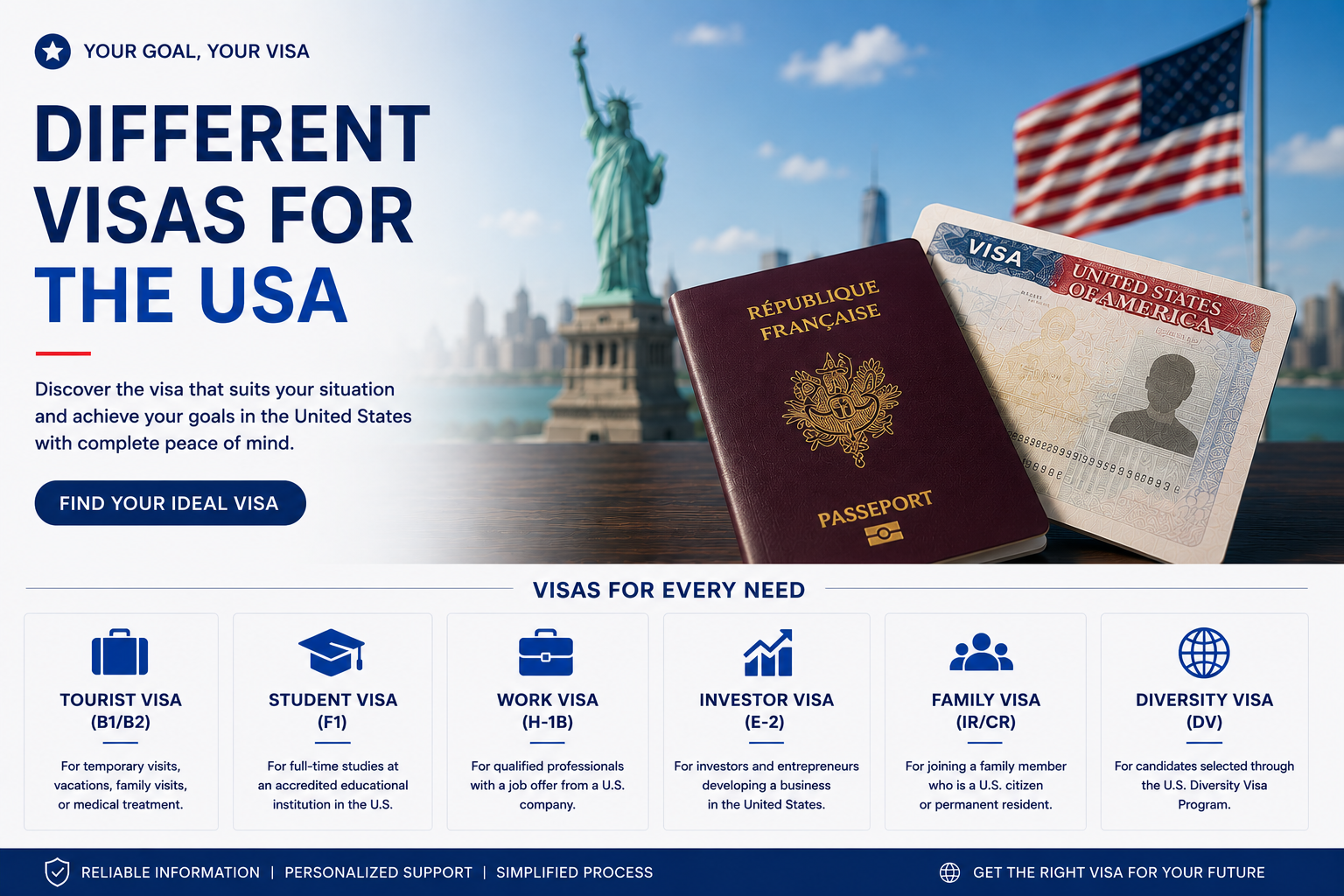
Types of U.S. visas, France-USA-Net.Com illustration, U.S. English version

Types of U.S. Visas: Complete 2026 Guide

Overview of the main nonimmigrant and immigrant categories for French nationals: tourism, study, work, cultural exchange, and permanent residence. Fees, timelines, and requirements change often; confirm official fee schedules before you file. This page is educational and does not replace immigration counsel.

DS-160 MRV France travel.state.gov

The United States separates nonimmigrant stays (limited duration, intent to return) from immigrant paths leading to permanent residence. For most applications filed abroad, the DS-160 form and payment of MRV fees (Machine Readable Visa) go through the consular portal. Employer or family petitions often run through USCIS before the consular interview.

Amounts below are indicative. Confirm them on travel.state.gov (visa fees) and uscis.gov/fees on the date you apply.

Filter categories

Tourism

Electronic travel authorization without a consular visa

ESTA / VWP
ESTA fee (indicative) ~$41 USD indicative amounts: verify on official sites as of your review date

Purpose

Short tourist or business stays (up to 90 days per visit) without a consular visa, for nationals of countries in the Visa Waiver Program, including France.

Eligibility

  • Valid biometric or electronic passport
  • Nationality of a VWP member country (France included)
  • Stay of 90 days or less for authorized purposes (tourism, limited business, transit)
  • No disqualifying factors (prior visa denial, criminal record, etc.)
  • Approved carrier and return or onward ticket
Duration ESTA valid for 2 years or until passport expiration; max. 90 days per visit (CBP)

Process

  1. Check eligibility on travel.state.gov (Visa Waiver Program)
  2. Complete the ESTA application on the official CBP site
  3. Pay online and keep your confirmation number
  4. Travel with passport and approved ESTA

Renewal and change of status

Renew ESTA online before it expires or when you get a new passport. ESTA does not allow work, full-time study, or a change of status inside the United States. Any other plan requires a consular visa or USCIS petition.

Online processing: response usually within minutes to 72 hours
Tourism

Business or pleasure visitor

B-1 / B-2
MRV fee (indicative) ~$185 USD indicative amounts: verify on official sites as of your review date

Purpose

Temporary stay for tourism, family visits, or limited business activities (meetings, negotiations without local paid employment). Required when ESTA is not available or not sufficient.

Eligibility

  • Intent to stay temporarily with sufficient ties to your country of residence
  • DS-160 completed and MRV fees paid per travel.state.gov
  • Passport valid beyond your planned stay
  • Proof of funds and lodging if requested
  • No INA-based disqualification
Duration Admitted up to 6 months per entry (CBP I-94); visa often valid 10 years with multiple entries for French nationals

Process

  1. Complete the DS-160 at ceac.state.gov
  2. Pay MRV fees and keep your receipt
  3. Schedule a consular appointment (Paris or other competent post)
  4. Attend the interview and submit your passport if approved

Renewal and change of status

Consular renewal before expiration, or a renewal interview if eligible. Change of status (F-1, H-1B, etc.) through USCIS is possible from inside the U.S. in some cases, under strict conditions and without guarantee.

Consular wait time: varies by season (DOS Visa Appointment Wait Times tool)
Tourism

Immediate and continuous transit

C-1
MRV fee (indicative) ~$185 USD indicative amounts: verify on official sites as of your review date

Purpose

Transit immediately and continuously through the United States to a third country when the traveler cannot complete the trip without a U.S. layover.

Eligibility

  • Onward ticket to a third country already booked
  • Transit without leaving the authorized area, or a very brief continuous stay
  • Valid passport and completed DS-160
  • MRV fees paid and consular interview if required
  • No bar to entry
Duration C-1 status limited to transit time admitted by CBP, usually a few hours to one day

Process

  1. Complete the DS-160 under C-1 category
  2. Pay MRV fees
  3. Schedule a consular appointment and show proof of transit
  4. On entry, follow your itinerary and connection schedule

Renewal and change of status

C-1 does not allow you to remain or work in the United States. Any plan beyond transit requires another visa category. Renew consularly if you expect future transits.

Consular processing: a few weeks depending on post
Study

Academic student

F-1
MRV + SEVIS (indicative) ~$185 USD + I-901 indicative amounts: verify on official sites as of your review date

Purpose

Full-time academic study at a SEVP-certified institution (university, high school, approved language program).

Eligibility

  • Admission from a SEVP-approved school and Form I-20
  • I-901 SEVIS fee paid before the consular visa
  • Proof of funds for tuition and living expenses
  • Documented nonimmigrant intent (214(b) rule)
  • DS-160 and consular interview
Duration Length of program plus regulatory grace period; status tied to I-20 and F-1 maintenance

Process

  1. Receive admission and I-20 from the school
  2. Pay the I-901 SEVIS fee at fmjfee.com (official site)
  3. Complete the DS-160 and pay MRV fees
  4. Attend the consular interview with I-20, financial proof, and SEVIS receipt

Renewal and change of status

Extension through the school (new I-20) while status is maintained. CPT and OPT available under USCIS rules. Change to H-1B or another status via USCIS petition or new consular visa.

Processing: several weeks (SEVIS + consulate + CBP admission)
Study

Vocational and technical training

M-1
MRV + SEVIS (indicative) ~$185 USD + I-901 indicative amounts: verify on official sites as of your review date

Purpose

Non-academic vocational, technical, or practical training (trade school, flight training, culinary arts, etc.) at a SEVP-certified institution.

Eligibility

  • Admission from a SEVP school and Form I-20 (M category)
  • I-901 SEVIS fee paid
  • Full-time program with intent to return after studies
  • Sufficient financial proof
  • DS-160, MRV, and consular interview
Duration Program length plus 30-day grace period; very limited on-campus work, no general OPT like F-1

Process

  1. Receive M-category I-20 from the school
  2. Pay I-901 SEVIS fee
  3. Complete DS-160 and MRV payment
  4. Consular interview with full file

Renewal and change of status

Extension through the school if the program continues. Practical training (practicum) possible under strict rules. Change to F-1 is rare and tightly controlled; work status via H-1B or another route depending on eligibility.

Processing: several weeks depending on consulate and SEVIS
Exchange

Exchange visitor

J-1
MRV + sponsor (indicative) ~$185 USD + sponsor fees indicative amounts: verify on official sites as of your review date

Purpose

Cultural, academic, or professional programs supervised by a Department of State-designated sponsor (intern, researcher, professor, au pair, etc.).

Eligibility

  • Selection by an approved J-1 sponsor (j1visa.state.gov)
  • DS-2019 and specific program category
  • Health insurance meeting program requirements
  • Possible 212(e) rule (2-year home residency) depending on funding
  • DS-160 and consular interview
Duration Defined on DS-2019 per program (from a few months to several years)

Process

  1. Apply through an approved J-1 sponsor
  2. Receive DS-2019 and pay sponsor fees
  3. Complete DS-160 and MRV payment
  4. Consular interview with DS-2019 and insurance proof

Renewal and change of status

Extension possible through the sponsor if the program allows. The 212(e) rule may bar change of status or a green card without a waiver. Different from F-1 for standard degree study.

Timeline: sponsor coordination plus consulate, several weeks
Work

Specialty occupation

H-1B
MRV + USCIS + DOL (indicative) ~$185 USD + I-129 + LCA indicative amounts: verify on official sites as of your review date

Purpose

Employment in a specialty occupation with a sponsoring U.S. employer. USCIS Form I-129 petition, often preceded by a DOL Labor Condition Application (LCA).

Eligibility

  • Degree or equivalent experience in a specialized field
  • U.S. employer willing to sponsor and meet LCA wage requirements
  • Approved I-129 (or cap exemption if eligible)
  • Annual cap for part of filings (employer electronic registration in March)
  • DS-160 and consular visa after approval
Duration Initially up to 3 years, extensions possible; theoretical 6-year cap (USCIS recapture rules)

Process

  1. Employer files LCA with DOL
  2. USCIS electronic registration in March (if cap applies)
  3. File I-129 after selection or exemption
  4. DS-160, MRV, and consular interview after approval

Renewal and change of status

I-129 extensions while employment continues. Employer change via H-1B transfer (new petition). Common path to EB-2/EB-3 green card if the employer sponsors.

H-1B cap: March registration; petitions after lottery; USCIS times vary
Work

Temporary non-agricultural worker

H-2B
MRV + USCIS + DOL (indicative) ~$185 USD + I-129 + certification indicative amounts: verify on official sites as of your review date

Purpose

Temporary non-agricultural work (seasonal, peak load, one-time need) when qualified U.S. workers are unavailable.

Eligibility

  • Temporary job offer from a sponsoring U.S. employer
  • DOL temporary labor certification (no available U.S. workers)
  • Approved H-2B I-129 petition
  • Annual H-2B cap (often reached quickly)
  • Nationality of a DOS-listed eligible country
Duration Generally up to 1 year initially; extensions possible within a 3-year total limit

Process

  1. Employer obtains DOL temporary certification
  2. File and obtain H-2B I-129 approval
  3. Worker completes DS-160 and pays MRV
  4. Consular interview and CBP admission

Renewal and change of status

Extensions via new employer petition within regulatory limits. No typical dual intent: change to permanent status is rare without departing. Must leave when status ends.

Cap often exhausted early in fiscal year; DOL + USCIS + consulate timelines
Work

Intracompany transfer

L-1A / L-1B
MRV + USCIS (indicative) ~$185 USD + I-129 indicative amounts: verify on official sites as of your review date

Purpose

Transfer of an executive or manager (L-1A) or specialized-knowledge employee (L-1B) from a related foreign entity to a U.S. entity within the same corporate group.

Eligibility

  • Continuous employment abroad in the group (generally 1 year in 3)
  • Qualifying relationship between entities (parent, subsidiary, affiliate)
  • Documented executive or specialized-knowledge role
  • Approved I-129 (or L blanket program if eligible)
  • Consular visa and CBP admission
Duration L-1A: max. 7 years; L-1B: max. 5 years; initial admission 1 to 3 years by subcategory

Process

  1. U.S. employer prepares L I-129 petition
  2. USCIS approval or blanket filing at consulate
  3. DS-160, MRV, and consular interview
  4. CBP admission with intracompany proof

Renewal and change of status

I-129 extensions while transfer and role still qualify. L-1A may lead to EB-1C (multinational manager) for a green card. Employer change outside the group is not allowed in L-1 status.

USCIS: several months (premium processing optional if available)
Work

Extraordinary ability

O-1
MRV + USCIS (indicative) ~$185 USD + I-129 indicative amounts: verify on official sites as of your review date

Purpose

For individuals with extraordinary achievements in sciences, arts, education, business, or athletics, with demanding documentary evidence.

Eligibility

  • Advisory opinion or consultation per field
  • Contract or itinerary of U.S. events
  • Evidence file meeting USCIS O-1 criteria
  • U.S. employer or agent as I-129 petitioner
  • No annual cap like H-1B
Duration Up to 3 years initially; one-year increments on extension based on activity

Process

  1. Build evidence file and obtain advisory opinion
  2. File O I-129 with USCIS
  3. After approval, complete DS-160 and MRV
  4. Consular interview and CBP admission

Renewal and change of status

I-129 extensions while extraordinary activity continues. Possible path to EB-1A green card if criteria are met. Essential assistants may qualify for O-2.

USCIS review often lengthy; large evidence file
Work

Treaty investor

E-2
MRV + investment (indicative) ~$185 USD + investment indicative amounts: verify on official sites as of your review date

Purpose

Substantial, at-risk investment in an active U.S. business that the applicant develops and directs. France is an E-2 treaty country.

Eligibility

  • French nationality (treaty of navigation and commerce)
  • Real, irrevocable investment in an operating enterprise
  • Control of the business (50% or directing role)
  • Non-marginal enterprise (able to generate more than minimal income)
  • Complete E-2 consular file (business plan, proof of funds)
Duration Initially 2 to 5 years depending on consular post; renewals possible while criteria are met

Process

  1. Set up the U.S. company and invest funds
  2. Complete DS-160 under E-2 category
  3. Pay MRV and schedule consular appointment
  4. Interview with complete investment file

Renewal and change of status

Consular renewal or I-129 extension if already in the U.S. Spouse and children in E-2D status. Does not lead directly to a green card; EB-5 or another route if permanent residence is the goal.

File preparation: several weeks to months
Work

USMCA professional

TN
MRV if visa (indicative) ~$185 USD indicative amounts: verify on official sites as of your review date

Purpose

Classification for USMCA-listed professions. French nationals are not eligible: reserved for citizens of Canada and Mexico only.

Eligibility

  • Canadian or Mexican citizenship (not French)
  • Profession on the USMCA list
  • U.S. job offer or contract in that profession
  • Degree-level qualifications per profession
  • Alternatives for French nationals: H-1B, L-1, O-1, E-2, J-1, or EB routes
Duration 3-year renewal periods for eligible USMCA nationals

Process

  1. Canadians: CBP admission at the border with TN packet
  2. Mexicans: DS-160, MRV, and consular interview
  3. Employer letter describing role, salary, and qualifications
  4. Degree and experience proof

Renewal and change of status

TN renewal for eligible USMCA nationals. Not available to French nationals: consider H-1B, L-1, O-1, E-2, or EB routes to work in the United States.

Not applicable to French nationals
Exchange

Religious worker

R-1
MRV + USCIS (indicative) ~$185 USD + I-129 indicative amounts: verify on official sites as of your review date

Purpose

Ministers and religious workers employed by a nonprofit U.S. religious organization, with Form I-129 R petition.

Eligibility

  • Member of a recognized denomination for at least 2 years
  • Qualifying ministerial or religious role (not general secular work)
  • Eligible U.S. religious organization as petitioner
  • Approved I-129 with R supplement
  • Maximum 5 years in R-1 status (USCIS rules)
Duration Up to 30 months initially; extensions possible within a 5-year total limit

Process

  1. Religious organization files I-129 R
  2. Possible USCIS on-site inspection
  3. After approval, complete DS-160 and MRV
  4. Consular interview and CBP admission

Renewal and change of status

I-129 extensions within the 5-year limit. Possible change to permanent status via EB-4 (special immigrant religious workers) under strict conditions.

USCIS + consulate: several months
Immigration

Priority workers

EB-1
USCIS + consulate (indicative) I-140 + DS-260 indicative amounts: verify on official sites as of your review date

Purpose

Permanent residence (Green Card) for extraordinary ability, outstanding professors or researchers, or multinational executives.

Eligibility

  • Evidence meeting EB-1 criteria (extraordinary, outstanding, multinational manager)
  • Approved USCIS I-140 petition
  • Current priority date in Visa Bulletin (often current for EB-1)
  • I-485 adjustment in the U.S. or consular DS-260 processing
  • Medical exams and police certificates
Duration Permanent (green card) once admitted as a lawful permanent resident

Process

  1. Build EB-1 evidence file
  2. File I-140 (self-petition EB-1A or employer EB-1B/EB-1C)
  3. Wait for current priority date (Visa Bulletin)
  4. I-485 or DS-260, interview, and green card issuance

Renewal and change of status

Green card renewed every 10 years (physical card). Naturalization possible after 5 years of permanent residence, under USCIS conditions.

Several months to years depending on route and Visa Bulletin
Immigration

Skilled workers

EB-2 / EB-3
PERM + USCIS (indicative) DOL + I-140 + visa indicative amounts: verify on official sites as of your review date

Purpose

Green card through employment for advanced-degree holders (EB-2) or skilled workers, professionals, and other workers (EB-3). Often requires DOL PERM certification before I-140.

Eligibility

  • Permanent job offer and sponsoring employer
  • PERM (except EB-2 NIW without employer)
  • Approved I-140 and Visa Bulletin priority date
  • Education or experience level per subcategory
  • I-485 or consular processing based on residence
Duration Permanent residence after final step approval

Process

  1. Employer runs recruitment and PERM with DOL
  2. File I-140 after certified PERM
  3. Monitor Visa Bulletin for priority date
  4. I-485 or DS-260, medical exam, and interview

Renewal and change of status

Green card renewable every 10 years. Employer change possible during I-485 if AC21 rules are met. Long waits by nationality (possible retrogression).

PERM alone: often 6 to 12+ months; full path multi-year
Immigration

Fiancé(e) of a U.S. citizen

K-1
USCIS + consulate (indicative) I-129F + MRV indicative amounts: verify on official sites as of your review date

Purpose

Enter the United States to marry a U.S. citizen within 90 days, then file adjustment of status (I-485) for permanent residence.

Eligibility

  • In-person meeting within 2 years before petition (limited exceptions)
  • Good-faith intent to marry a U.S. citizen
  • Approved USCIS I-129F petition
  • Consular processing and medical exam
  • Eligible children in derivative K-2 status
Duration K-1 status: 90 days to marry; then AOS path to Green Card

Process

  1. U.S. citizen files I-129F with USCIS
  2. After approval, case transfers to consulate (NVC / consular post)
  3. DS-160, medical exam, and consular interview
  4. Enter the U.S., marry within 90 days, then file I-485

Renewal and change of status

K-1 does not renew: marriage required within 90 days. After marriage, file I-485 for conditional Green Card (2 years if recent marriage).

I-129F: often 6 to 12+ months; consulate follows

Typical consular process from France

Eight general steps for most nonimmigrant visas filed from France. Immigrant routes (EB, K-1) often start with USCIS before the consulate.

  1. 1. Determine the visa type

    Identify the category that matches your plans on travel.state.gov and uscis.gov. Choosing the wrong category delays or derails your case.

  2. 2. Gather documents

    Valid passport, financial proof, employer or admission letters, I-20 or DS-2019 if applicable, evidence of ties to France, and translated documents when required.

  3. 3. Pay MRV fees

    Pay fees per the official travel.state.gov (visa fees) schedule and keep your receipt before scheduling any appointment.

  4. 4. Complete the DS-160

    Fill out the form online at ceac.state.gov, download the confirmation with barcode, and use a photo that meets Department of State requirements.

  5. 5. Schedule a consular appointment

    Book biometrics and interview through the U.S. Embassy in France system and enter your DS-160 number.

  6. 6. Attend the consular interview

    Bring originals and copies. The consular officer evaluates eligibility, consistency of your plans, and ties to France (214(b) rule for nonimmigrants).

  7. 7. Track processing

    After the interview, check status on CEAC. If approved, the visa is usually placed in your passport within a few business days.

  8. 8. Enter the U.S. and verify your I-94

    On arrival, a USCBP officer decides admission. Verify class and date immediately at i94.cbp.dhs.gov.

Key points for your application

Application process

Most nonimmigrant visas from France go through the online DS-160 (CEAC), MRV payment, biometrics and interview scheduling at the consulate, then CEAC tracking. After entry, download your I-94 at i94.cbp.dhs.gov.

H-1B cap calendar

Employers targeting an October start date typically follow USCIS electronic registration in March, with selection and I-129 filing in spring. Check the official H-1B page each year: exact dates change.

J-1 / F-1 insurance

J-1 programs and F-1 schools require minimum health coverage (amounts and duration set by sponsor or school). Under-insurance can end your status: verify requirements on DS-2019 or I-20.

MRV fees, SEVIS (I-901), USCIS petition fees (I-129, I-140, I-485, etc.), and immigrant consular fees are published separately by the Department of State and USCIS. No amount on this page replaces an official invoice; fee schedules can change without notice. Always verify current rates as of your review date.

Planning a project in the United States?

Contact us for an initial orientation. For complex cases, work with a qualified U.S. immigration attorney.