First things first
1. Why start a nonprofit in the United States?
Forming a nonprofit can give a solid framework to a charitable, educational,
cultural, or community project. A recognized structure builds donor trust, opens
access to certain grants, and, once it earns 501(c)(3) status, lets donors deduct
their gifts. In return, the organization takes on lasting transparency and
compliance duties. Clarify your mission, audience, and funding model first: the
legal structure should serve the project, not the other way around.
Tax-exempt status
2. Understanding the structures: 501(c)(3), 501(c)(4), and others
"501(c)" refers to the section of the federal tax code that lists tax-exempt
organizations. The best-known category, 501(c)(3), covers
charitable, religious, educational, scientific, and literary purposes; gifts are
generally deductible, and partisan political activity is prohibited.
501(c)(4) covers social welfare and civic groups, which may do
more advocacy, but gifts are generally not deductible. Other categories exist (for
example 501(c)(6) for business leagues and chambers of commerce, 501(c)(7) for
social and recreational clubs). The category drives the application form, gift
deductibility, and filing obligations.
Steps
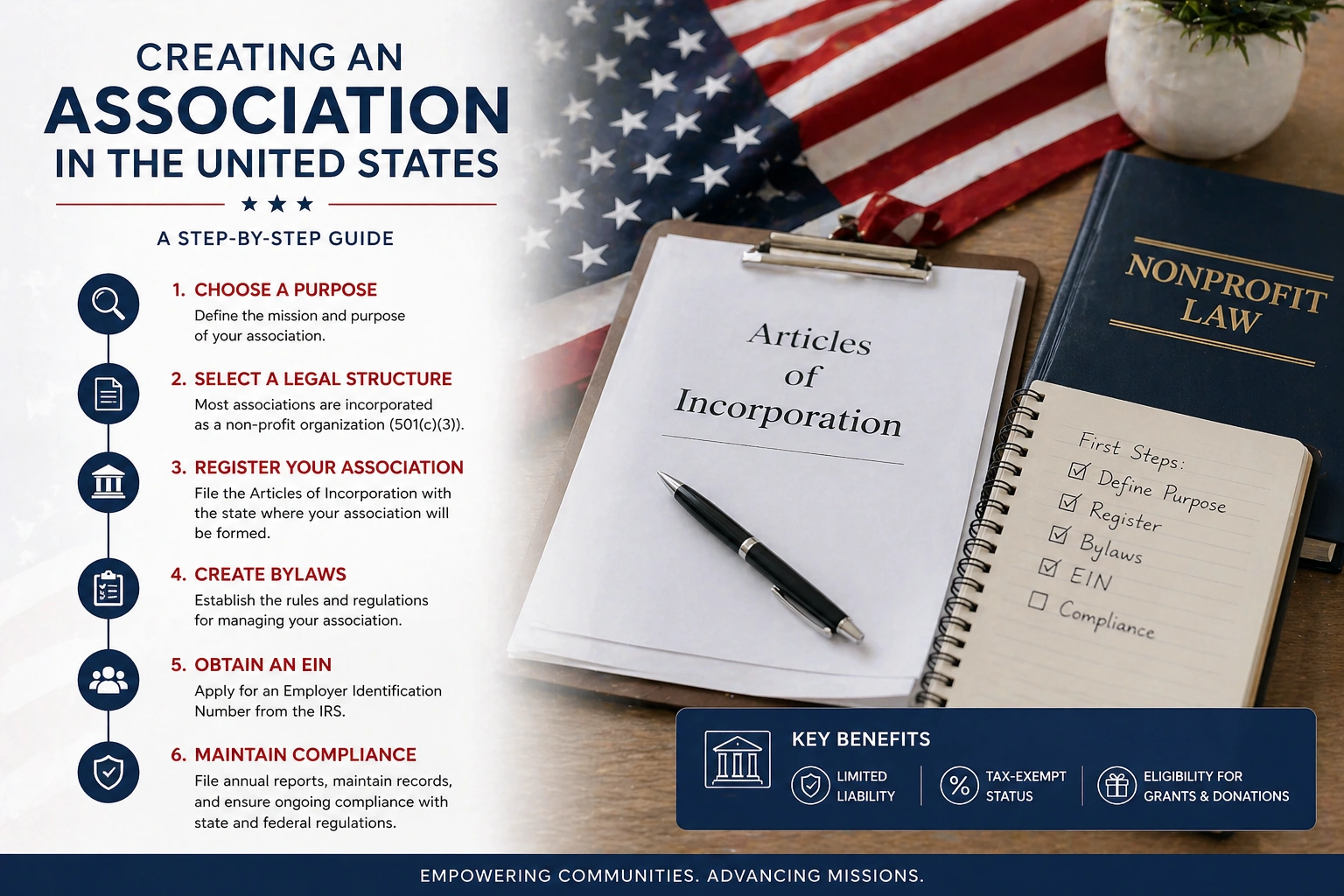
3. The full formation process in a U.S. state
Formation happens first at the state level, then federally for the exemption. The
usual steps: define the mission and activities; choose a name and check
availability with the state registry (and clear of conflicting trademarks); draft
and file the articles of incorporation with the Secretary of
State; appoint a board of directors; adopt bylaws and a
conflict-of-interest policy; obtain the EIN from the IRS; then
apply for federal exemption. Depending on the state, charitable solicitation
registration may be required before any fundraising.
4. Applying for exemption: Form 1023, 1023-EZ, 1024
Federal exemption is requested from the IRS after state formation. Form
1023 is the full application for 501(c)(3) status. Form
1023-EZ is a streamlined version for eligible small organizations
(subject to revenue and asset thresholds): check the official eligibility
worksheet first. Form 1024 is used to request recognition for
several other 501(c) categories. The 1023 and 1023-EZ are filed online through
Pay.gov with a user fee. Provide accurate information: an incomplete or inaccurate
application can be rejected or reclassified.
Apply for exemption, official IRS site
Compliance
5. Annual obligations: staying compliant
Exempt status is kept through compliance. Most exempt organizations file a
Form 990 series return each year: 990-N
(e-Postcard) for the smallest, 990-EZ or 990 by
size. Three consecutive years without filing trigger automatic revocation. Add
state duties (annual report, renewal of charitable solicitation registration),
recordkeeping, board meetings, and the ban on private inurement. Plan ahead for
IRS and state deadlines.
Non-residents
6. Can you start a nonprofit without being a U.S. citizen?
Yes, you can: there is generally no citizenship or residency
requirement to form a U.S. nonprofit or serve on its board. In practice,
a few points matter. You usually need a registered agent with a
physical address in the state of formation, plus a U.S. mailing address for
official correspondence. The EIN requires a responsible
party: without a U.S. taxpayer number (SSN or ITIN), you cannot use the
online tool and must file Form SS-4 by fax or mail. A few states
have specific board-composition rules: check your target state.
Key point
Forming a nonprofit grants no immigration right, visa, or
authorization to work or enter the United States. Admission to U.S.
soil rests solely with USCBP or USCIS officers.
At a glance
7. Comparison table of 501(c) types
Indicative reading: IRS Publication 557 lists all categories, the documents to
provide, and each one's obligations.
Steps
8. Official forms and steps (U.S. Government)
The process relies on a few key forms: SS-4 (to get the EIN),
1023 / 1023-EZ (501(c)(3) exemption), 1024 /
1024-A (other categories), and the 990 series (annual
return). The 1023 and 1023-EZ are filed online on Pay.gov; the EIN is obtained on
the IRS site (online with a U.S. taxpayer number, otherwise by SS-4). The business
registry and any charitable solicitation registration are handled by each state.
9. List of official links
EIN, compliance, and state
10. Bank account, EIN, registered agent
Three practical building blocks shape operations. The EIN is the
organization's federal identifier: required for banking, any hiring, and filings.
A dedicated bank account strictly separates the nonprofit's funds
from personal funds: banks typically ask for the articles of incorporation, the
EIN, the bylaws, and signers' IDs. The registered agent is the
person or company designated to receive official and legal documents on the
organization's behalf; they must have a physical address in the state. Most states
require one to keep the entity in good standing.
Frequently asked
11. FAQ
How many directors do I need?
The minimum varies by state (often one to three). A board of at least three
independent members is recommended for credibility and governance.
Is the EIN free?
Yes, getting the EIN from the IRS is free. Beware of paid third-party sites.
Which exemption form should I choose?
Form 1023-EZ if you are an eligible small organization, otherwise Form 1023
for 501(c)(3); Form 1024 or 1024-A for other categories.
What happens if I don't file the Form 990?
Three consecutive missed years trigger automatic revocation of exempt
status.
Do I need a lawyer?
It is not required, but a nonprofit attorney or a CPA greatly reduces the
risk of mistakes.
Can I convert a French association into a U.S. nonprofit?
No: these are two separate legal entities. You must form a U.S. organization
under local law.
Take it with you
12. PDF summary
Download our summary sheet (why start one, 501(c) structures, the formation
process, exemption forms, annual obligations, rules for non-residents, comparison
table, EIN and banking, FAQ, and official U.S. links), in the site's colors.
Indicative document: always verify the official source at the time you act.