Overview
1. What is a credit score?
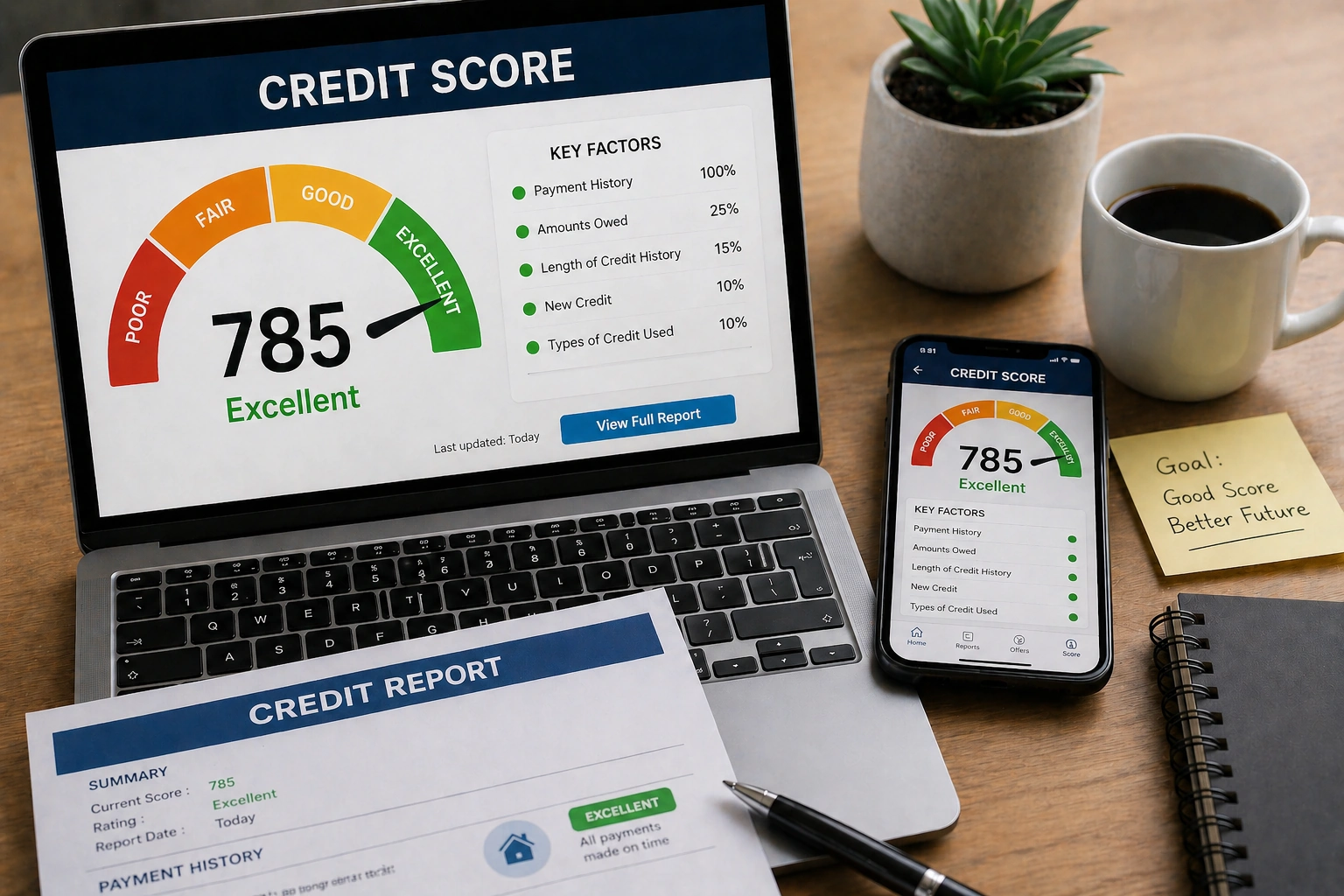
In the United States, your credit score is a number (often between
300 and 850 on the FICO model) that summarizes how reliably you
repay debt. It is calculated from your credit report, fed by banks,
card issuers, lenders, and sometimes utility companies. Unlike many countries, this
score shapes everyday financial decisions: mortgages, rentals, auto insurance,
some jobs, and phone plans.
New arrivals often start with no U.S. credit history. Building a
solid file takes time, consistency, and a clear understanding of the rules. This
guide relies on official sources (CFPB, FTC, AnnualCreditReport.com) without
promising quick fixes.
Scale
2. FICO scale: 300 to 850
The FICO score remains the benchmark most lenders use. The higher
the score, the better your rates, fees, and deposit requirements.
300850
300-579Poor
580-669Fair
670-739Good
740-799Very Good
800-850Excellent
Indicative FICO ranges; thresholds vary by lender.
Calculation
3. Factors that make up your score
The classic FICO model weights factors roughly as follows:
- Payment history (~35%): late payments, defaults, bankruptcies.
- Credit utilization (~30%): balance vs limit (often keep under 30%).
- Length of history (~15%): average account age and oldest account.
- Credit mix (~10%): cards, auto loans, mortgages, etc.
- New credit (~10%): recent hard inquiries.
Key takeaway: paying on time and keeping utilization low are the strongest levers.
Risk
4. Detailed consequences of a low score
A low score does not only block a loan: it can raise your cost of living in the USA.
Mortgages
Higher rates, larger down payments, denials even with steady income.
Credit cards
Low limits, high APRs (25%+), denials for premium or rewards cards.
Renting
Larger security deposits, co-signers required, denials in tight markets.
Utilities
Deposits required for electricity, gas, or water before service starts.
Auto insurance
Higher premiums in many states where credit is part of pricing.
Employment
Some employers check credit for finance roles or access to funds.
Phone service
Postpaid plans denied or device deposits required.
Collections
Accounts in collection, legal fees, prolonged administrative stress.
Vicious cycle
Credit denials, costly products, further score damage.
Action
5. Build and improve your score
1. Open a tracked account
Secured card or credit-builder loan if you have no history.
2. Always pay on time
Enable minimum autopay and pay the balance when possible.
3. Control utilization
Stay under 30% of limits, ideally under 10% before applying for credit.
4. Limit new applications
Space hard inquiries 6 to 12 months apart.
5. Fix errors
Dispute in writing with the bureau and keep proof.
6. Monitor regularly
Review all three reports through AnnualCreditReport.com each year.
Roadmap
6. 12-month plan to raise your score
Phase 1: months 1 to 3
Pull three free reports, list errors, open a secured card, enable autopay.
Phase 2: months 4 to 6
Dispute errors, cut utilization below 30%, avoid new applications.
Phase 3: months 7 to 9
Negotiate legitimate collections, maintain zero late payments, diversify lightly.
Phase 4: months 10 to 11
Verify bureau updates, prepare a loan or rental file.
Phase 5: month 12
Annual review, new free reports, adjust strategy for the next year.
Comparison
7. FICO vs VantageScore
Tool
8. 12-month checklist PDF
Download our printable checklist to track credit actions month by month.
Monitoring
9. Monitor your report through AnnualCreditReport.com
- Go to AnnualCreditReport.com (the authorized site for free annual reports).
- Click "Request your free credit reports" and complete the form.
- Choose a bureau (Equifax, Experian, or TransUnion), then verify your identity.
- Download or print the report and note any errors (balances, unknown accounts, late marks).
- Repeat for the other two bureaus (spread across the year for quarterly checks if you prefer).
The CFPB notes this service may not always include your FICO score, but the full report does.
Correction
10. Dispute an error on your report
If information is wrong, you can dispute it under the FCRA.
- Gather proof (statements, payoff letters, ID).
- Contact the bureau online or by mail (Equifax, Experian, TransUnion).
- The bureau must investigate within 30 days (45 in some cases).
- If the creditor confirms the error, the bureau corrects or deletes the entry.
- If that fails, file a CFPB complaint at consumerfinance.gov/complaint.
CFPB guide: dispute an error
Rights
11. Collections: your FDCPA and FCRA rights
Collection agencies cannot do everything. The FDCPA limits harassment and requires clear information. The FCRA lets you dispute inaccurate entries.
- Request written debt validation within 30 days of first contact.
- Demand that communications stop if you ask in writing (except lawsuits).
- Dispute any inaccurate report entry, including collections.
- Never admit a doubtful debt without document verification.
CFPB tools: debt collection
Case studies
12. Three detailed scenarios
Marie, age 34, score 610
Two card late payments in 2024, 68% utilization on a $3,000 limit. Plan: autopay, drop to 25% in 60 days, dispute an erroneous telecom account. Target: 680 in 9 months.
610 → target 680
John, age 28, no history
New resident, no U.S. accounts. Opens a secured card ($500 deposit), spends $50/month, pays in full. After 6 months, estimated VantageScore around 680, FICO still building.
Thin file → target 700+
Sarah, age 45, score 540
$1,200 medical collection, 90% utilization, three credit applications in 3 months. Plan: validate debt, payment plan, freeze applications for 12 months. Expected gain: +80 to +120 points in one year with zero new late payments.
540 → target 650+
FAQ
13. Frequently asked questions
What is the difference between a credit score and a credit report?
The report lists your accounts, balances, and incidents. The score is a number calculated from that data using a model (often FICO or VantageScore).
Can I get my report for free?
Yes. Through AnnualCreditReport.com you can request one free report per bureau per year. Avoid paid look-alike sites.
How long does it take to improve a score?
Some changes show up in weeks (lower utilization), but lasting recovery often requires 6 to 12 months of consistent behavior.
Should I close an old credit card?
Usually not: an old, lightly used card can help average account age and overall utilization if fees stay under control.
Is my FICO score the same at all three bureaus?
Not necessarily: each bureau receives different data and may use slightly different model versions.
What if a collection agency contacts me?
Request written debt validation, review your report, dispute errors, and know your FDCPA rights before paying.
Steps
14. Official steps and useful links
- Get your free reports at AnnualCreditReport.com.
- Understand scores and reports through the CFPB.
- Dispute an error with the relevant bureau or via the CFPB guide.
- File a complaint at consumerfinance.gov/complaint if needed.
- Know your rights under the FCRA (FTC) and FDCPA (FTC).
Takeaway
15. Summary PDF
Download our summary sheet (FICO scale, factors, 12-month plan, comparison, disputes, FDCPA/FCRA rights, and official links).