A complete, factual guide to the American electoral process: from the Iowa caucus to inauguration at the Capitol, covering the Electoral College, swing states, and voting methods. Built for citizens, international observers, and anyone following U.S. democracy.
538 electors · 270 required Next election: Nov 3, 2028 FEC & Archives sources
0Electors
0Votes needed to win
050 states + D.C.
0Term length (max. 2)
Overview
1. Introduction
The U.S. presidential election is one of the world's most closely watched democratic
events. Every four years, more than 330 million people participate,
directly or through electors, in choosing the federal chief executive. The constitutional
framework rests on Article II, Section 1 (1787), refined by the
12th Amendment (separate ballots for president and vice president),
the 22nd Amendment (two-term limit), and the
23rd Amendment (three electors for Washington, D.C.).
The last election was held on November 5, 2024. The next is scheduled
for November 3, 2028, set by federal law as the
first Tuesday after the first Monday in November. Between those dates, parties
nominate candidates through primaries and conventions, then run a general campaign
focused on a handful of competitive swing states.
Core principle: citizens vote for a slate of electors; electors then
cast the formal ballots for president and vice president. The national popular vote
shapes the outcome, but winning requires an Electoral College majority.
Electoral College
2. Electoral College
Established by the Constitution (1787), the Electoral College balances
direct election with congressional selection. Citizens vote for a slate of
electors who, in December, formally vote for president and vice
president under the 12th Amendment.
Winner-takes-all: in 48 states, the statewide winner receives all electors.
Maine and Nebraska: split some votes by congressional district.
Popular vote ≠ presidency: a candidate can win nationally and lose the Electoral College (2000, 2016).
0Electors (California)
0Minimum per state (+ D.C.)
Key fact: California holds 54 electors (2020 census);
Wyoming, Vermont, and Alaska each hold only 3, reflecting population
weight in the federal system.
Primaries
3. Primaries & conventions
The two major parties (Democrats and Republicans) choose nominees through
primaries (ballot voting) and caucuses (party meetings).
Delegates gather at national conventions (summer of the election year)
to formalize the presidential ticket.
Closed primaries
Only party-registered voters may participate (roughly half of states).
Open primaries
Any registered voter may participate regardless of party affiliation.
Caucuses
Local meetings (Iowa traditionally opens the season) where members debate and vote.
Conventions
Official nomination of the candidate and running mate; major policy speeches.
Calendar
4. Election cycle calendar
The American election cycle spans nearly two years. Here are the major phases from preparation through inauguration:
Preparation
Primaries, conventions, and general campaign
January through October: caucuses and primaries (Iowa, New Hampshire, Super Tuesday), national conventions in July-August, then the general campaign with televised debates and swing-state mobilization.
Election Day
Tuesday, November 3, 2028
Federal elections fall on the first Tuesday after the first Monday in November. Voters cast ballots in person, early, or by mail depending on state rules. Last election: November 5, 2024.
Post-election
Certification and Electoral College vote
Each state certifies results and appoints electors. In December, electors meet in state capitals. On January 6, Congress certifies the count (reformed by the 2022 Electoral Count Reform Act).
Inauguration
Presidential oath on January 20
The president-elect takes the oath at the Capitol and begins a four-year term. The 22nd Amendment limits presidents to two elected terms.
Infographic
5. Process infographic
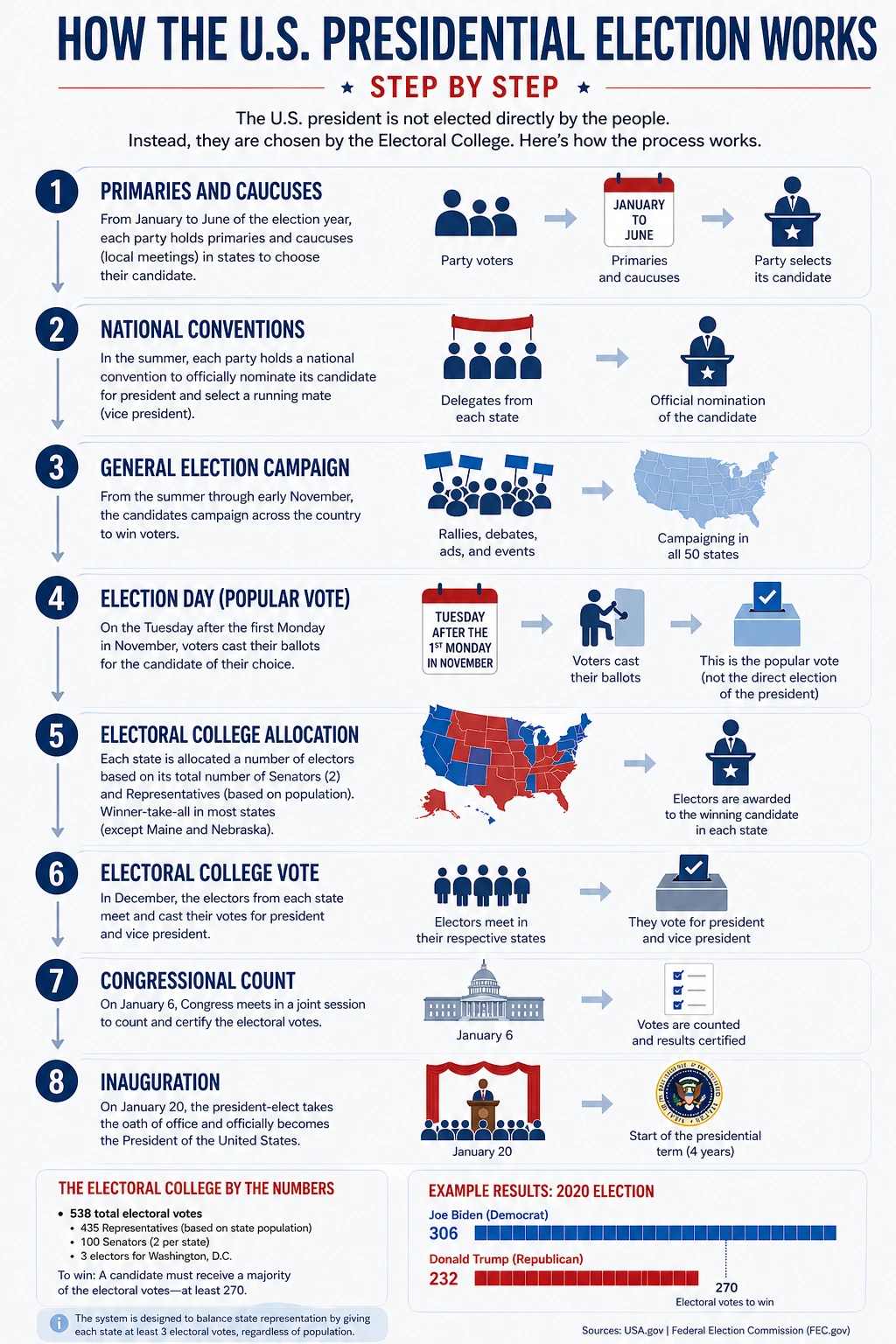
Diagram of the U.S. presidential election process, from nomination to inauguration.Voting
6. Voting methods in the United States
Election Day voting: local polling places, typically 7 a.m. to 8 p.m. (varies by state).
Early voting: available in most states, often 1-3 weeks before Election Day.
Mail-in / absentee voting: rules vary widely; some states mail ballots automatically.
Drop boxes: secure deposit of mail ballots at official locations.
2020-2024: mail-in and early voting reached record levels. Always check
your Secretary of State or
vote.gov
for current rules in your state.
Registration
7. Voter registration
To vote in federal elections, you generally must:
Be a U.S. citizen (by birth or naturalization).
Be 18 on Election Day.
Reside in the state where you vote (residency period varies, often 30 days).
Be registered before your state's deadline (some allow same-day registration).
Register online: vote.gov (official federal portal).
Swing states
8. Swing states
Under winner-takes-all rules, campaigns concentrate resources on
swing states, where outcomes remain competitive. In 2024, Pennsylvania,
Michigan, Wisconsin, Arizona, Georgia, Nevada, and North Carolina played decisive roles.
Their electoral makeup can shift each cycle.
Comparison
9. USA vs France comparison
Two presidential republics with sharply different electoral traditions.
Voting method
Electoral College
538 electors · 270 required
Direct two-round vote
Citizens vote directly for the president
Term & frequency
4 years
First Tuesday after the first Monday in November
22nd Amendment: max. 2 terms
5 years (quinquennat)
Election typically in April
Max. 2 consecutive terms
Nomination
Primaries & caucuses → conventions → general election
Recurring debates include abolishing or reforming the Electoral College, ballot and
machine security, voting access, fighting disinformation, and campaign finance (super
PACs, FEC). The Electoral Count Reform Act (2022) clarified January 6
procedures to prevent abusive challenges to certified results.
FAQ
11. Frequently asked questions
How many electoral votes are needed to win the presidency?
A minimum of 270 of 538 Electoral College votes is required to be elected president.
Transparency: France-USA-Net.Com is not the FEC, the National Archives, or vote.gov. This is educational content; verify rules with official sources before taking any electoral action.